Introduction
This article takes a detailed look, with real examples, at the advantages American travel trailers have over European ones. It is written primarily for staff of American companies working at RV shows where American and European RVs are displayed side by side. Armed with the facts in this article, any representative of an American company can easily convince a customer to choose an American trailer over a European one.
What’s more, a sales rep at an American show who has read this article will feel far more confident with customers, and that will help boost the company’s sales.
When working at European shows, however, I recommend avoiding direct comparisons.
For example, saying “American trailers have a better toilet, and European ones have a worse one” is the wrong approach.
Saying “American trailers have a ceramic toilet and a 139-liter (37-gallon) black tank, which makes them more self-sufficient and more eco-friendly” is the right approach.
This article will also be of interest to future RV buyers in the US, since it covers RVs in general: heating systems, off-grid capability, winter use, and more.
Why American Trailers Are Much Better and Cheaper Than European Ones
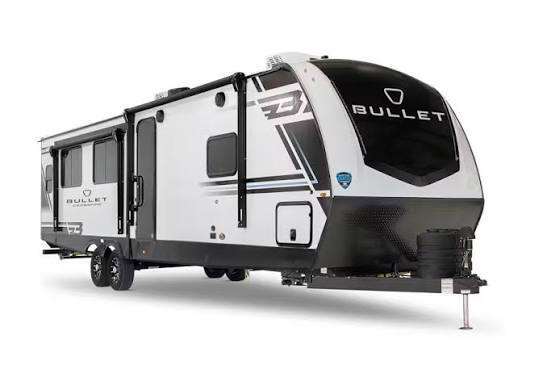
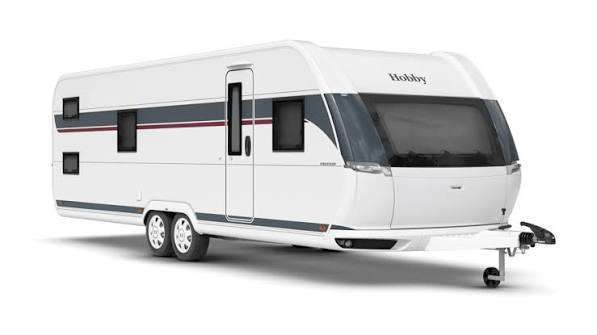
Why are American trailers so much better and cheaper than European ones?
To answer that question, let’s look at how American trailers differ from European ones.
Hot Water and Plumbing Systems: European vs. American Trailers
The Toilet
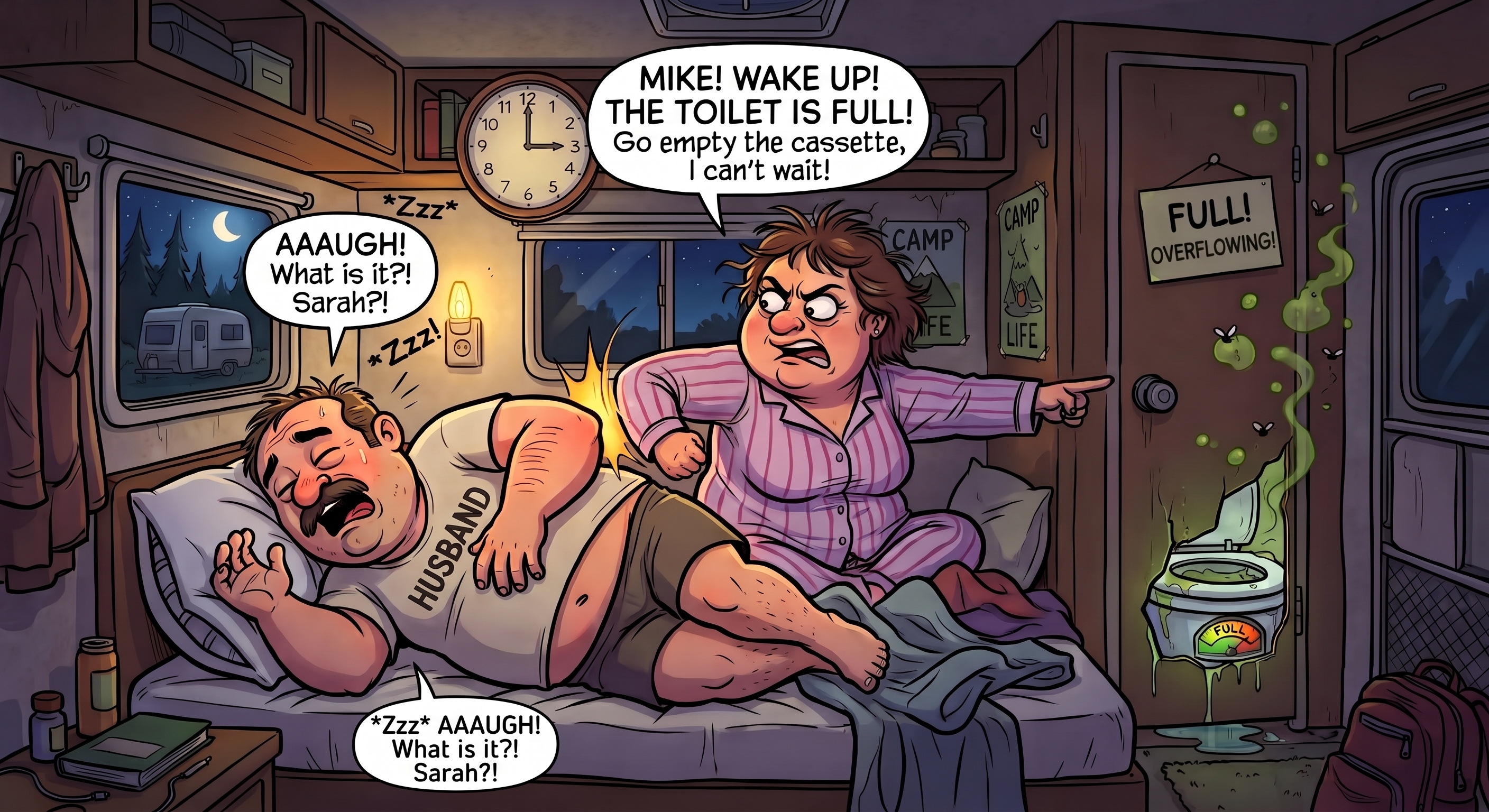
American trailers don’t come with a 20-liter (5-gallon) cassette toilet, the kind you have to deal with every single day: hunting for a dump station at the campground or along the road, emptying out, well, everything, and often getting splashed with you-know-what in the process. On top of that, thanks to Murphy’s Law and that tiny capacity, the European cassette always seems to fill up in the middle of the night. And your warning light isn’t the little lamp in the bathroom. It’s your wife’s elbow in your ribs at 3 a.m. Then off you go, half-asleep, looking for the nearest dump station somewhere within a hundred yards of your European trailer.

In an American trailer, everything is different. The black tank, where all those “biological fluids” of yours go, holds 139 liters (37 gallons). Even the smallest trailers have 118 liters (31 gallons). That’s six to seven times more than in European trailers. It means that whether you’re at a campground or boondocking, you don’t have to think about dumping the black tank for a full seven days.
Meanwhile, European trailer owners spend their whole vacation working it out: where’s the septic tank, where are the nearest bushes (yes, that happens too), where’s the nearest restroom, and when is it time to dump.
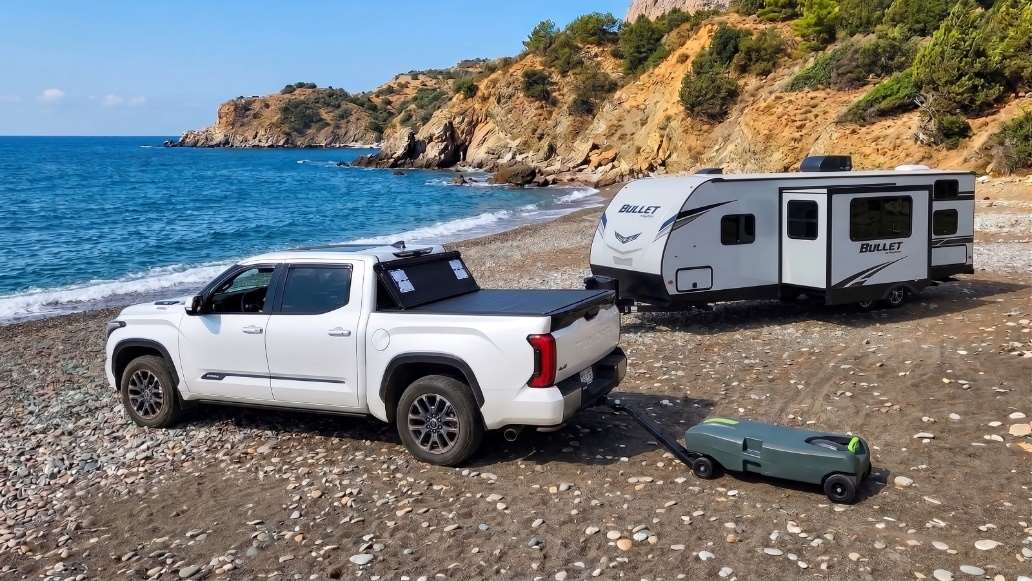
Dumping the black tank is very well thought out in an American trailer too, even if you stay in one place for more than 10 days and let the tank fill up completely. Say you want to stay a couple more days, but the black tank is already full. You don’t need to haul the whole trailer somewhere to the side of the road and back. Just drain it into a portable waste tank on wheels, hook it to your tow vehicle’s hitch, and take it to the dump station. That rarely happens, though, because the onboard tank is more than enough for 7–10 days of camping.
Hot Water
In American trailers, every water heater runs on both propane and electricity, whereas in European trailers, every water heater is electric. A gas water heater in a European trailer is an expensive option. American trailers use tankless water heaters, while European ones use tank-type heaters. What does that mean? In an American tankless (on-demand) water heater, the water heats up instantly as it flows through and goes straight to the tap. In a European heater, the water first has to fill the tank, heat up there, and only then reach the tap. Hence the names: tankless and tank-type. As a result, an American trailer always has hot water, while in a European one, once the tank is used up, you have to wait for the next batch of hot water.

Text on the illustration: Title: “WATER HEATING IN RVs COMPARED:” Top and bottom captions: “AMERICAN RV (TANKLESS WATER HEATER)”

Text on the illustration: Top and bottom captions: “EUROPEAN RV (TANK-TYPE WATER HEATER)”
The Suburban Nautilus IW60RL System
Because American trailers have tankless water heaters, they can be fitted with the Suburban Nautilus IW60RL system. This system circulates the water that has gone cold in the trailer’s pipes until it heats up. As soon as the water reaches the right temperature, it is automatically sent to the tap. You have to agree, that matters a lot when you’re off-grid. European trailers have nothing like this. You have to run the water down the drain until it gets hot.
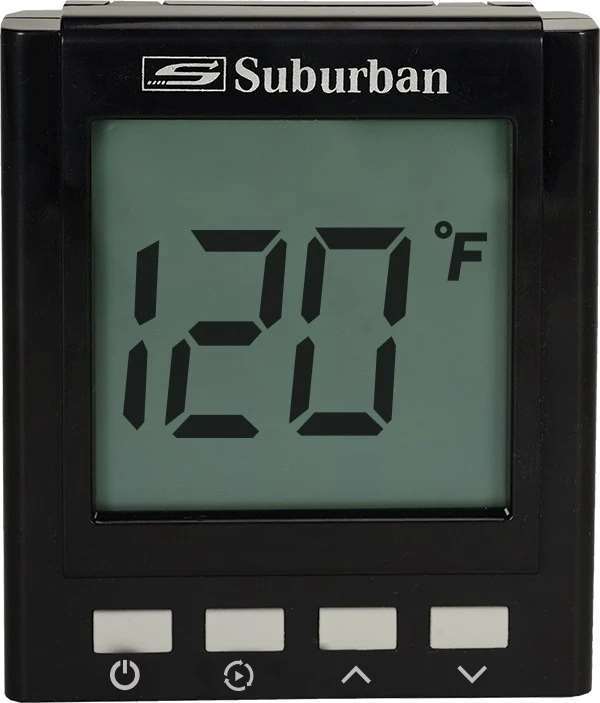
All of this should be explained
and demonstrated at European
shows, but nobody does it.
Cold Water Supply. Installing Washing Machines and Dishwashers in a Trailer
Cold water supply in American trailers works exactly the same way as at home: the plumbing system is always under pressure, supplied not only by city water but also by the trailer’s onboard pump. This makes it possible to install a washing machine and a dishwasher in an American trailer.

In a European trailer, constant pressure in the plumbing system is only possible at campgrounds, and only with extra equipment installed. Away from campgrounds, constant water pressure is impossible altogether, because the pump only builds pressure when a faucet is opened and triggers a micro-switch. That rules out installing a washing machine or a dishwasher in a European trailer.

Heating and Air Conditioning
Air Conditioning
Heating and air conditioning deserve an article of their own, but I’ll try to cover them here and now. You don’t need to be a certified heat and power engineer, which I am, to understand that warm air always rises and cold air sinks. If you’re indoors, look around. The radiators that heat your room are at the bottom, and the split-system AC units that cool it are at the top. This placement creates natural air circulation and the indoor comfort we’re all so used to.
European trailer manufacturers apparently never went to engineering school and aren’t exactly overburdened with brains. They started putting air conditioners down under the bed and running the ducts with vents along the bottom of the trailer. Natural circulation is out of the question. As a result, to cool off even a little in the heat, you have to sit right in front of a vent and point it at yourself. Not a pleasant experience.
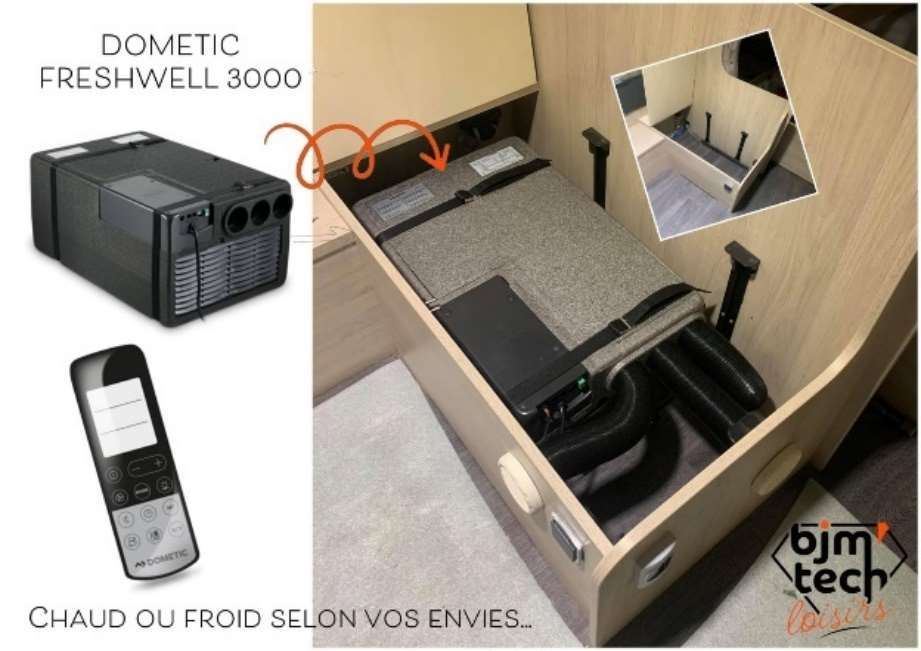
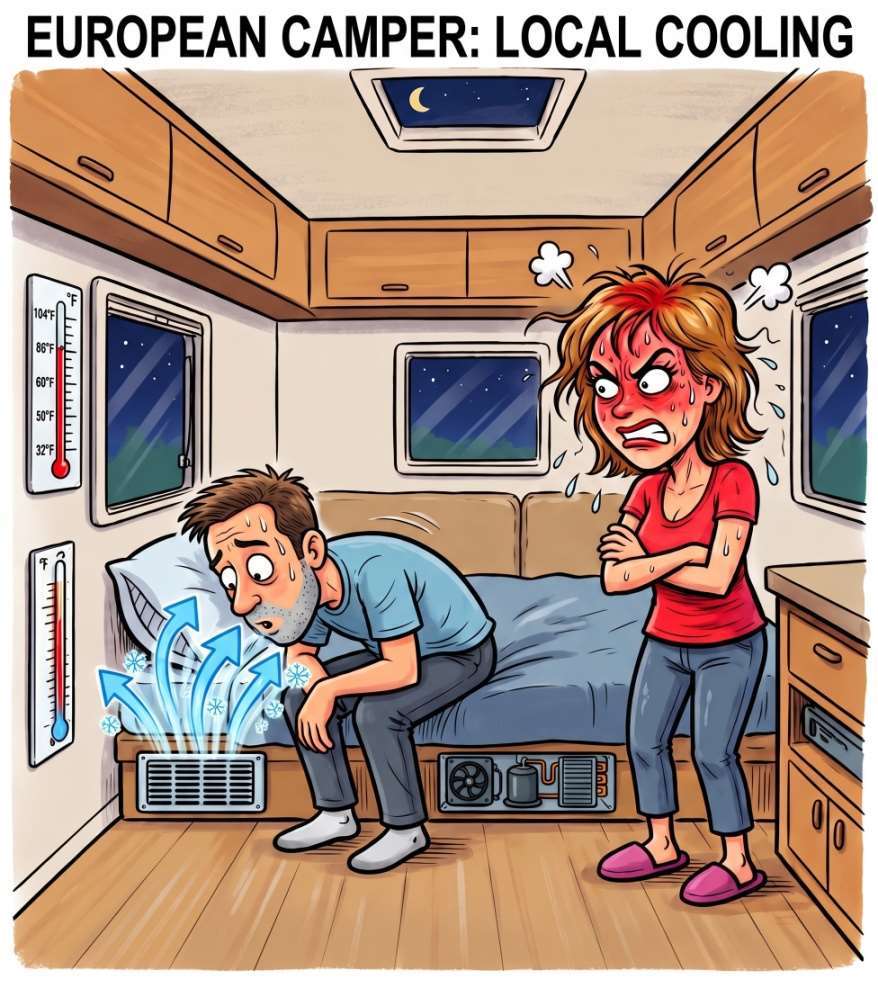
Text on the illustration: Title: “EUROPEAN CAMPER: SPOT COOLING”
In American trailers, air conditioners are always installed in the ceiling. On top of that, ducts run inside the roof and carry cold air to the other rooms.
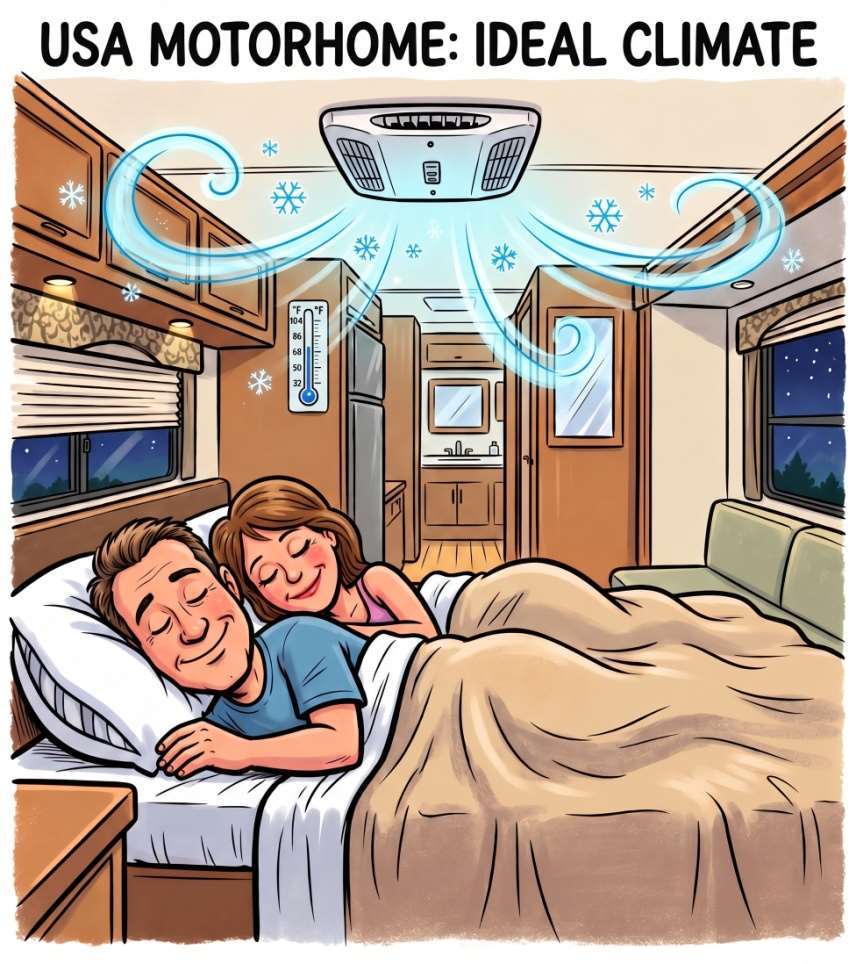
Text on the illustration: Title: “US RV: PERFECT CLIMATE”
Heated Floor
The heated floor in American trailers is a work of engineering art. Let me explain why. All American trailers have very high ground clearance. It’s needed for better off-road capability. But that high clearance serves another purpose too: it leaves room for the gray tank under the floor. Gray water is what drains into the tank after you wash your hands, the dishes, and so on. The gray tank sits under the floor, ducts carrying warm air from the furnace run around it, and the whole thing is enclosed in polypropylene. The result is a powerful, free heat accumulator that also gives you a free heated floor running on propane. And it’s not an extra-cost option; it’s standard equipment. In an American trailer, you don’t need shore power to keep the floor warm. It’s always warm, everywhere. Even away from campgrounds.

European trailers have much lower ground clearance. That leaves no room for gray tanks under the floor, which means a European trailer has no thermal cushion. If a European trailer doesn’t have the heated floor option, traveling in it in hard frost is very uncomfortable. The floor of a European trailer is very cold even when the air inside is warm, and the only part of our body that is always in contact with some surface is our feet. In winter, living in a European trailer without the heated floor option is impossible, especially for children.
European trailers can be fitted with a heated floor as an option, but it only runs on 220 V shore power, which means the floor will always be cold away from campgrounds. To live comfortably in a European trailer in winter, you need a campground, and since most campgrounds are closed in winter, the most exciting winter trips with European trailers become impossible.
A few years ago, European trailer manufacturers started offering a heated floor powered by the Alde heating system as an extra option, which, in my opinion, was not a very sound decision. Back in university, at the Faculty of Thermal Power Plants, we were taught that you should never install heat exchanger tubes in different rigid media in transportation systems. That’s exactly what European manufacturers did. When closing deals, I strongly advised my clients against this flawed heated floor. In the end, I was proved right. Every trailer with this “wet” heated floor started leaking.
Alde heated floor in a European trailer

General Heating
In American trailers, heating efficiency gets a boost from the slide-out, a wall section that extends outward. Why?
Take an ordinary long tube with sealed ends, with the air inside at about 30 °C (86 °F), and place it in a cold environment. After a while, the air in the middle of the tube will be warmer than the air at its ends. The temperature difference between the middle and the ends will be large.
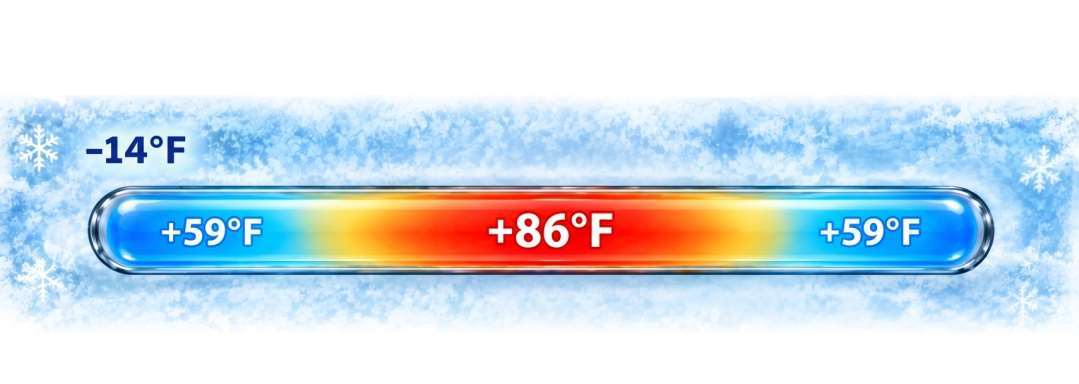
If you make the tube thicker in the middle, the temperature difference between the middle and the ends will be smaller. In other words, the tube warms up more evenly when it’s thicker in the middle.
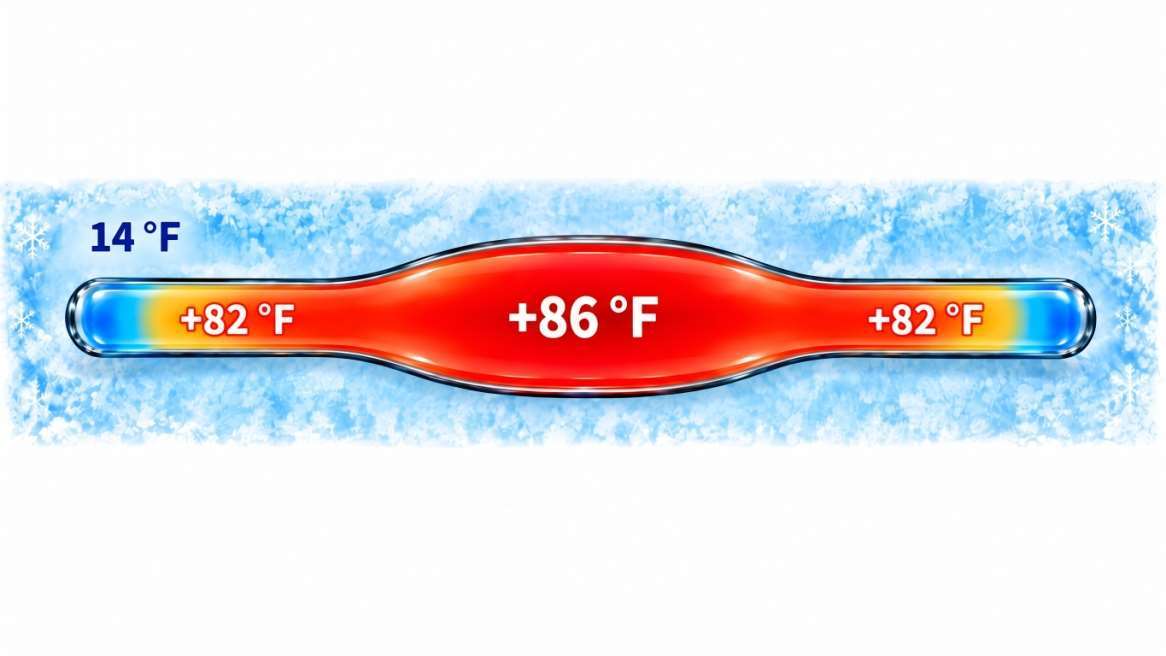
That thicker section is the slide-out. Thanks to slide-outs, American trailers heat up more evenly. American trailers have a climate certification, which is issued only if the temperature difference between the ends and the middle of the trailer is no more than 0.5 °F at an outside temperature of −16.5 °C (2 °F).
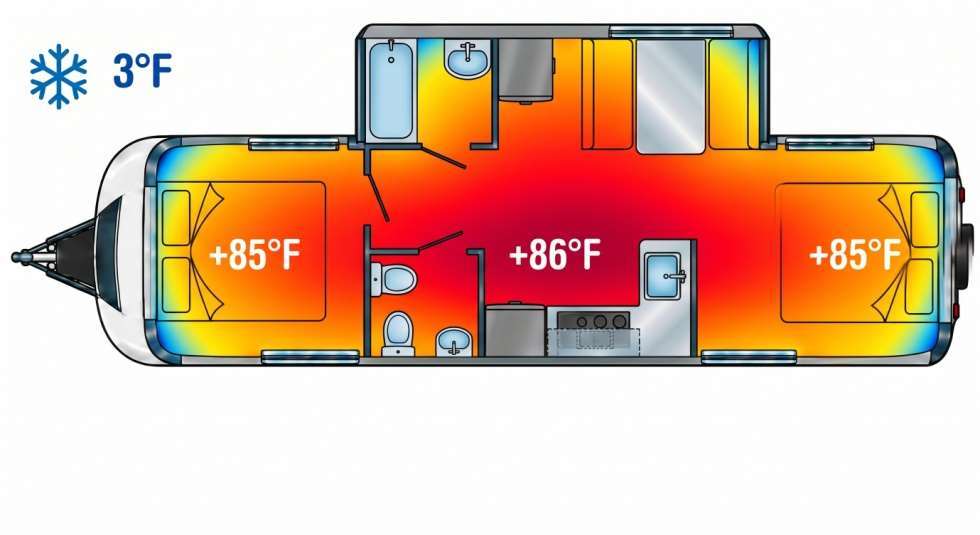
What a Winter Trip Above the Arctic Circle in Severe Arctic Cold Revealed
Dumping Gray Water in Severe Cold
Just a reminder: gray water is the water we’ve used to wash the dishes, our hands, or ourselves. It’s slightly soapy.
In January 2018, my company organized an RV trip above the Arctic Circle. Eight trailers took part. Temperatures in Finland dropped as low as −27 °C (−17 °F).
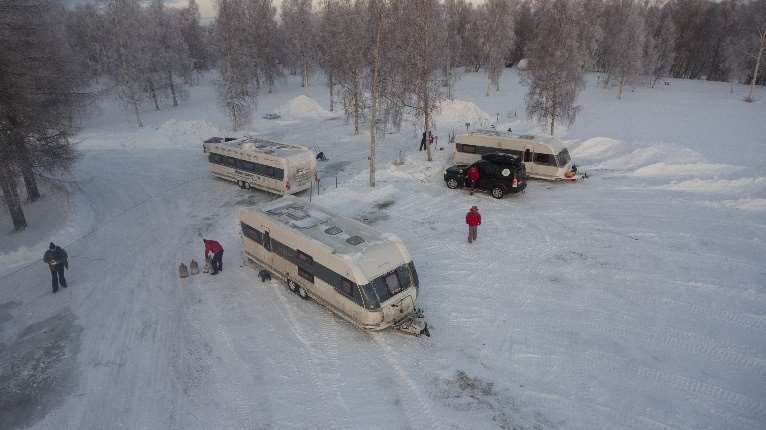
All the European trailers immediately lost the ability to drain gray water, and with it, their water supply.
The thing is, under a European trailer, out in the open air, a horizontal manifold runs along the perimeter and collects gray water from the vertical drains. With the outlet valve to the external tank closed, any water that gets into it freezes right away. For example, you stop at a gas station or a rest area and turn on the faucet: the gray water flows into the horizontal manifold and stays there, because the valve to the external tank is closed. The water in the manifold freezes instantly.

There’s no way to heat this manifold. It’s too big.
American trailers have no such manifold. Gray water never leaves the warm zone: it goes straight into a large heated gray tank and stays there. Gray water is dumped either from a heated utility center, where the water doesn’t freeze, or from a short branch, a drain valve coming out of the warm zone, which is easy to keep warm with heat tape.
Rain Gutters
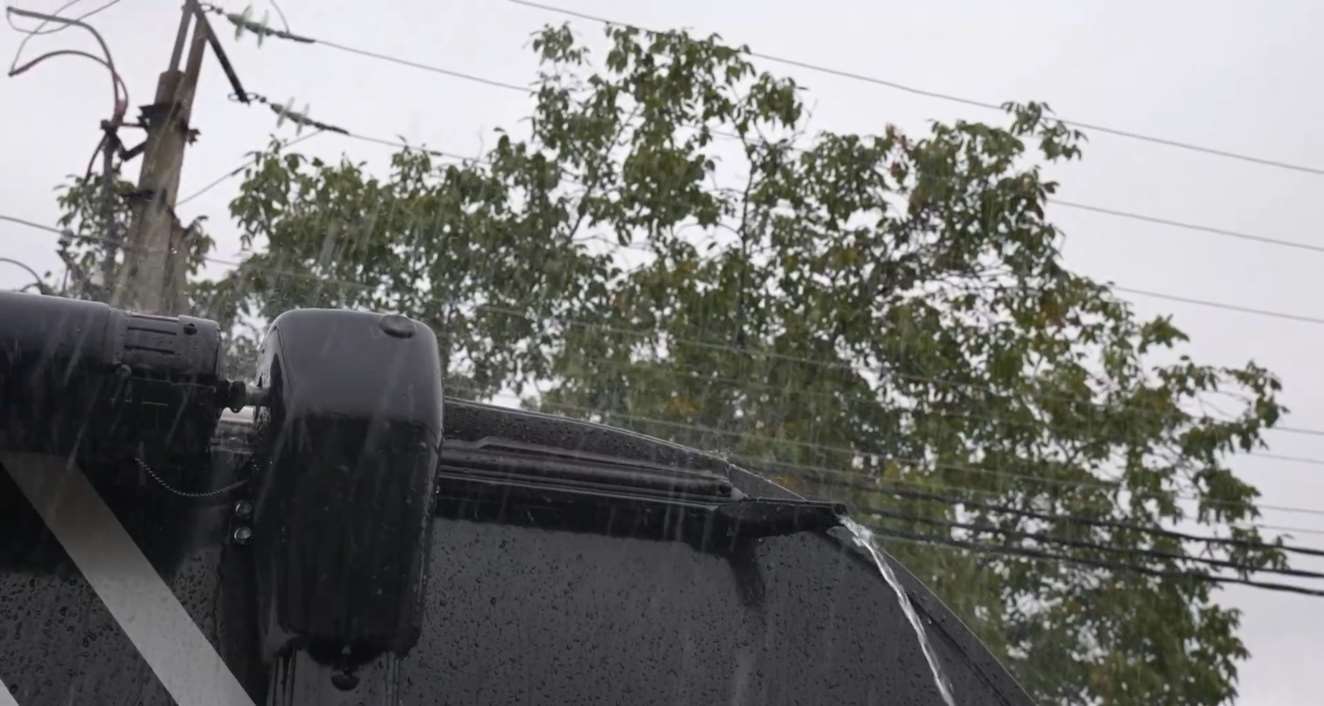
This is an important part of any trailer. Rainwater shouldn’t run down the sides at random, seeping under the marker lights, corroding electrical contacts, causing short circuits again and again, leaving dirty vertical “black streaks,” and getting into the windows and, if there are cracks, into the living space of the trailer.
European trailers have no rain gutters at all.
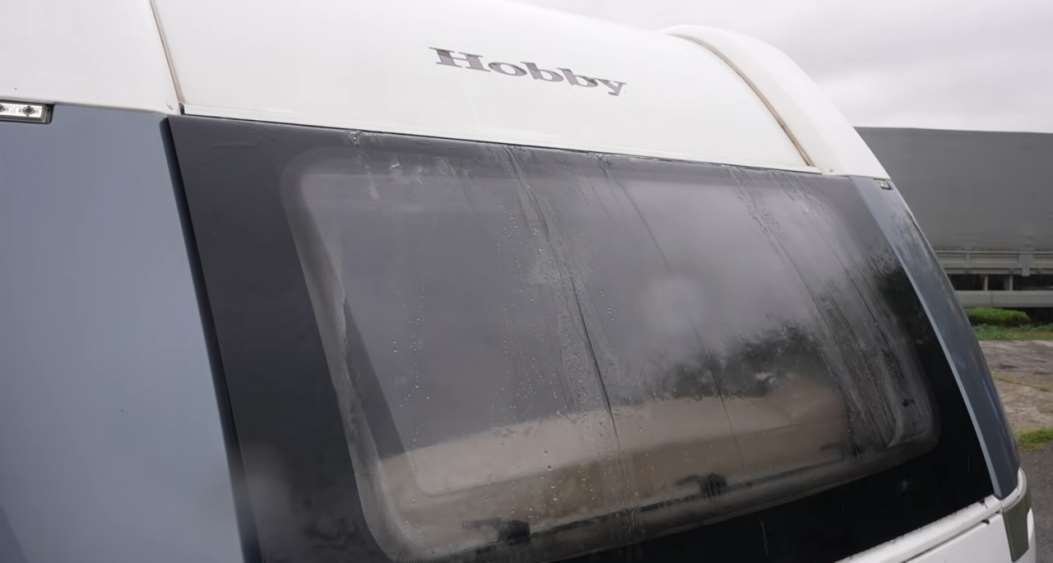
In American trailers, the rain gutters end in special plastic extensions called gutter spouts. They stick out a few centimeters (about an inch) beyond the body, so the water drips straight onto the ground without touching the camper’s walls.
Gas Hydrates
During the Arctic trip, at −27 °C (−17 °F), two European trailers lost their heating and had to go home, spending the nights in ordinary hotels. The propane tanks were full and the heating equipment was in perfect working order, yet no gas was reaching the furnace. The gas line was blocked by gas hydrates.
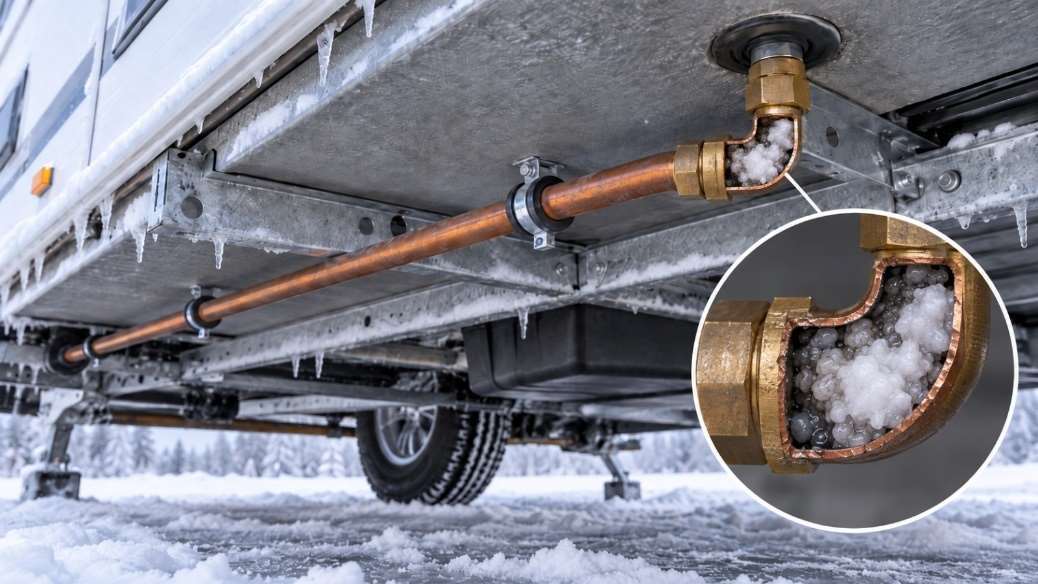
To understand this, just picture a person running down a very narrow (bookmark this) dark corridor with a 90-degree turn. Running at full speed, he slams into the wall in front of him and knocks himself out. The same thing happens to the person running right behind him, and so on. Eventually, the corridor is blocked at that turn. The same thing happens at the bends of a trailer’s gas line.
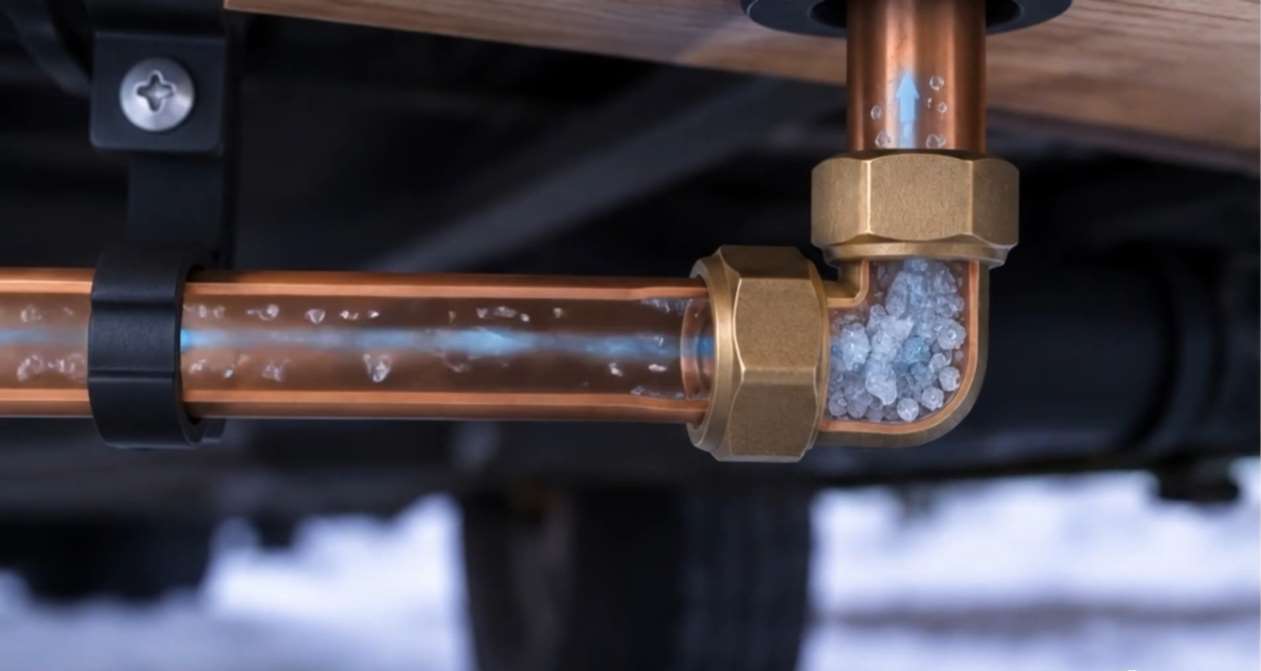
The more bends there are and the narrower the pipe, the higher the chance of gas hydrates forming.
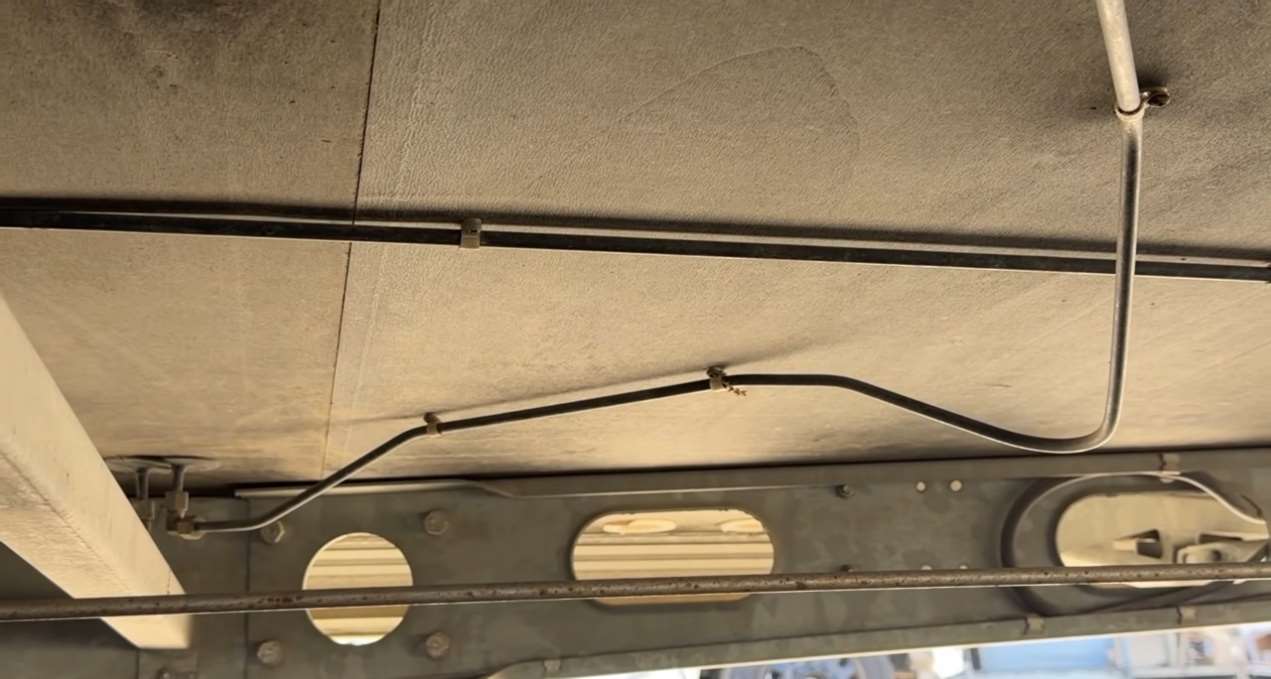
This is the gas line of a European trailer
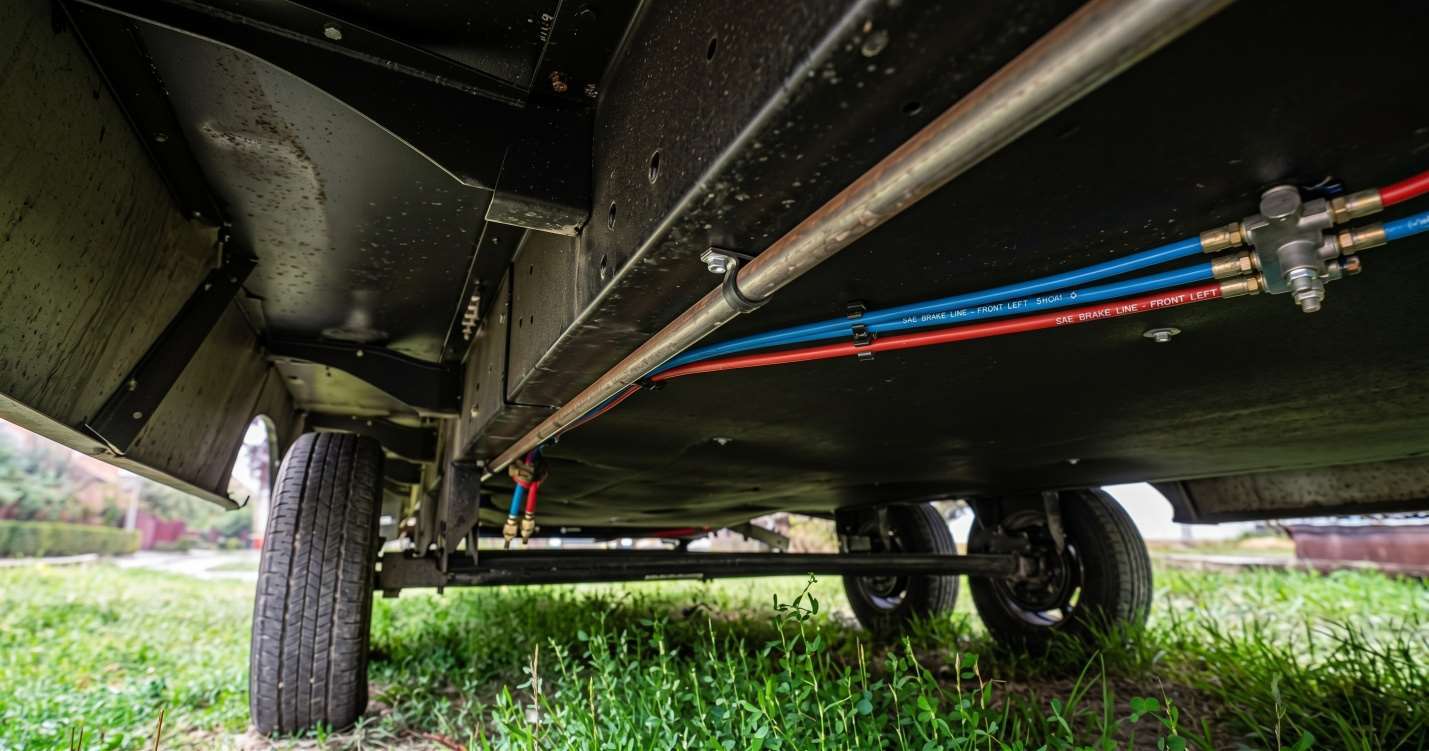
This is the gas line of an American trailer
The neat routing and the number of bends in the American trailer speak for themselves.
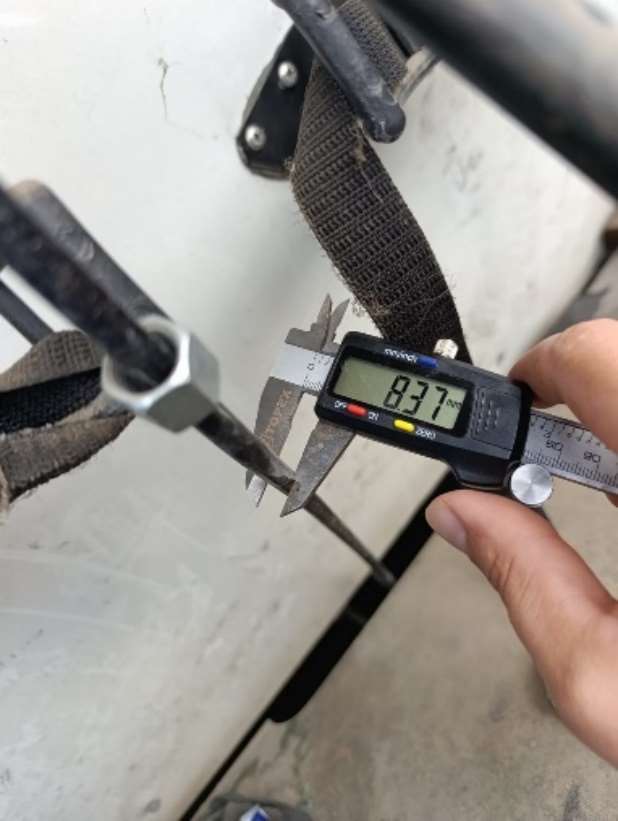
Diameter of the European trailer’s gas line, that very corridor (back to our bookmark): 8.37 mm
Diameter of the American trailer’s gas line: 19.46 mm
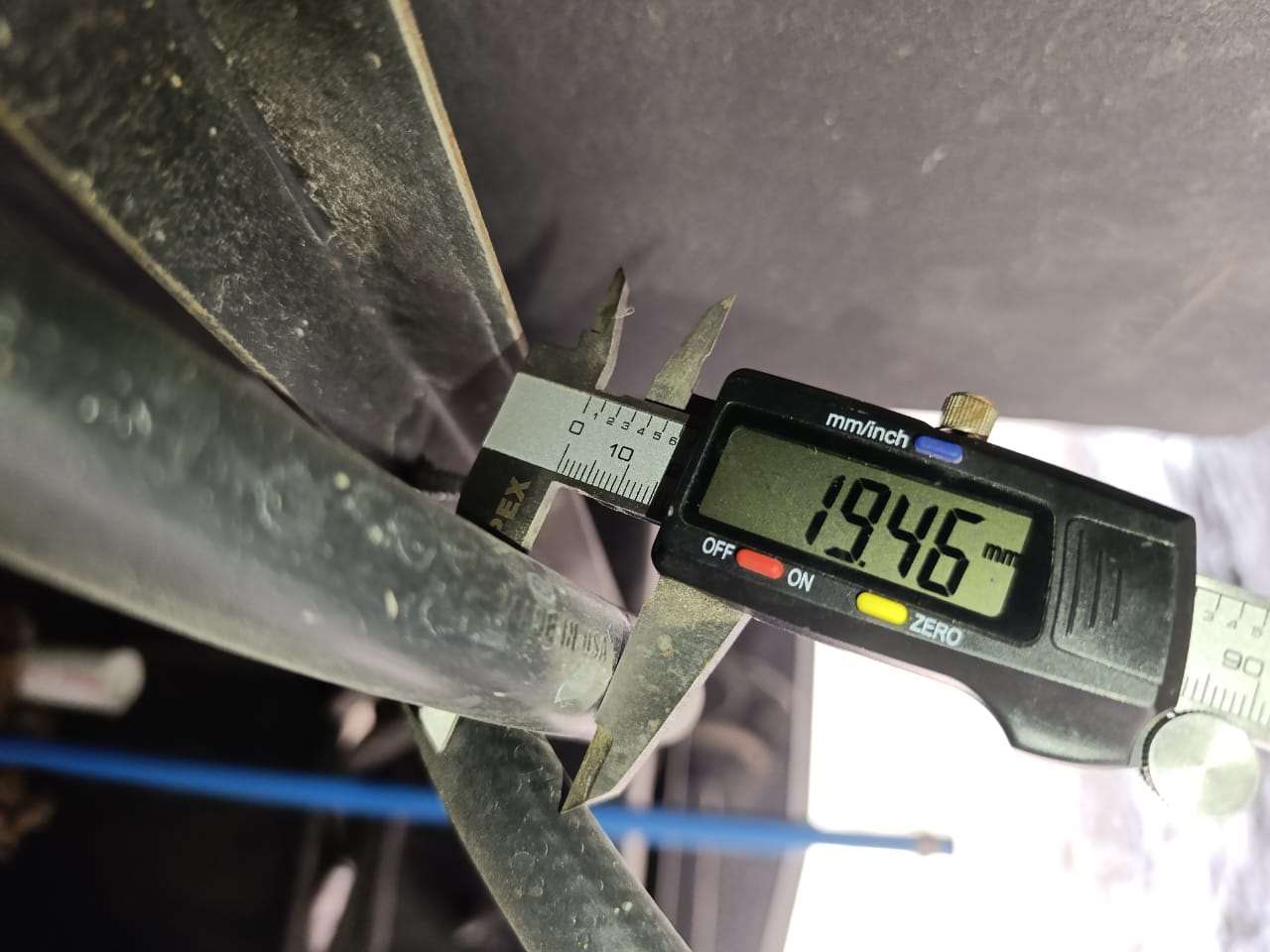
So we can see that gas hydrates are much less likely to form in an American trailer: there are fewer bends and turns, and the gas line is much wider.
How to Eliminate Ice Plugs Completely: The European and American Solutions
European solutions:
European heavy-ends gas filter
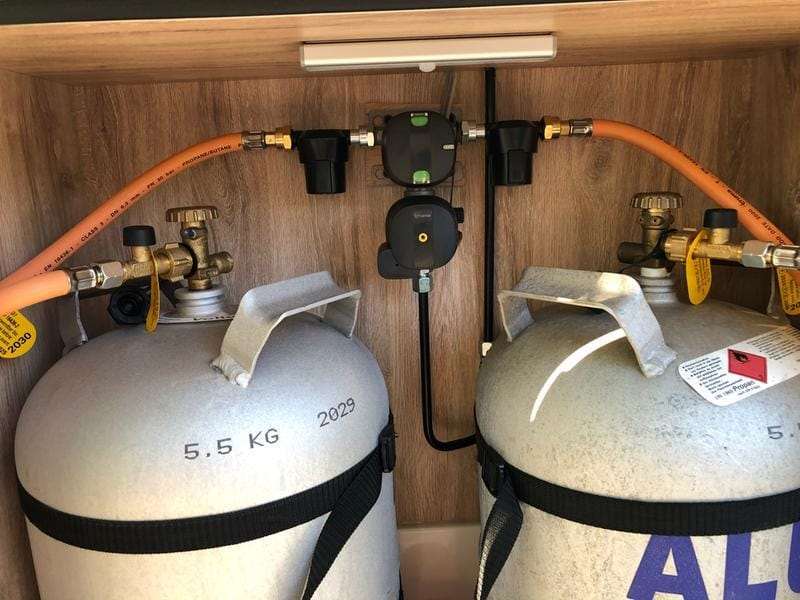
A so-so solution. It’s a consumable that needs servicing or replacing every six months. As a rule, a traveler remembers this two hours before the trip, and the nearest RV shop doesn’t have it in stock. “Set it and forget it” doesn’t work here.
European gas pre-heating system in the gas regulator:

This device solves two problems: it warms the gas in winter (a furnace runs more efficiently on warm gas) and prevents ice plugs in the section between the regulator and the furnace.
But the Europeans didn’t solve the problem of ice plugs forming in the tank itself. The tank sits upstream of the heated regulator, and that’s exactly where the Joule–Thomson effect comes into play: the change in temperature of a gas or liquid during adiabatic throttling. In simple terms, when you open the tank valve and gas starts flowing, it gets very cold. So you can end up with an ice plug even with the European gas pre-heating system installed, and at only moderately low temperatures. What’s more, in very severe cold, the gas in the furnace can condense and turn into liquid, leaving the trailer without heat.
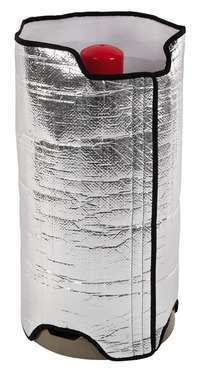
The Americans came up with a very simple solution, and here “set it and forget it” really works. Ice plugs are completely ruled out all the way from the tank to the furnace. The furnace runs efficiently because it gets pre-warmed gas. The propane tanks are always warm, so gas condensation in them is ruled out. A simple and brilliant solution.
The Frame of American and European Trailers
The frame is the key structural element of any trailer. It’s like a house’s foundation: the thicker and stronger it is, the longer the house will stand and the farther the trailer will go.
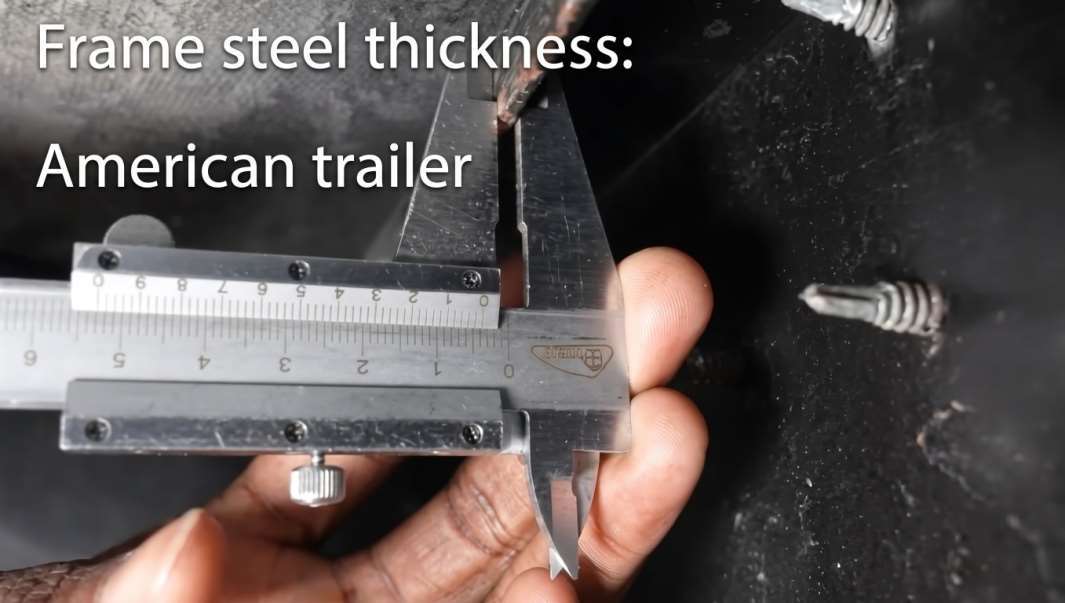
The frame of an American trailer is 3.8 mm thick.
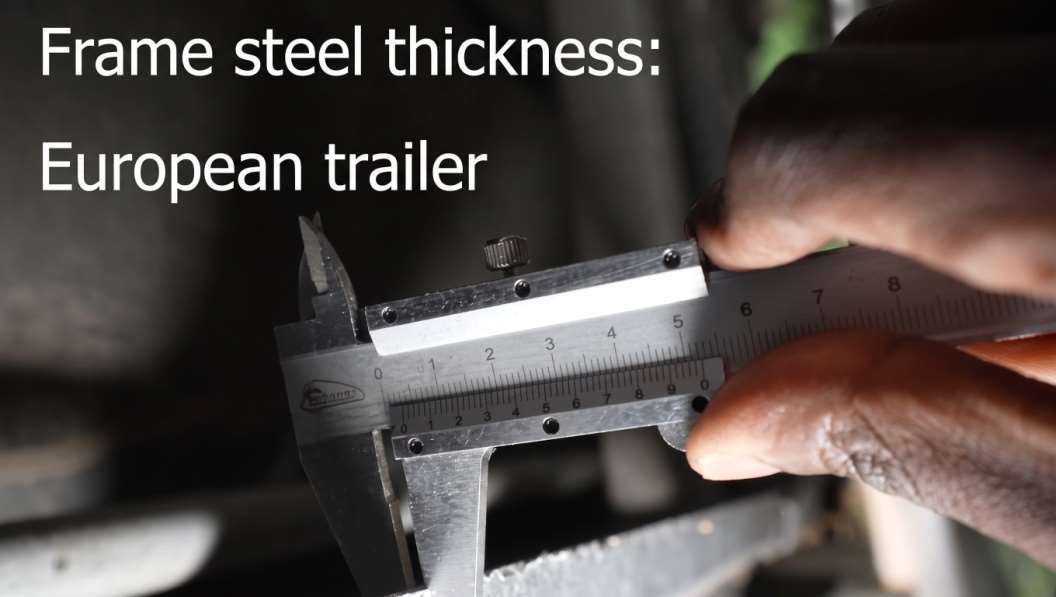
The frame of a European trailer is 3.3 mm thick.
The frame members of an American trailer are riveted together, just like on an airplane. Rivets give individual structural members some freedom of movement under heavy loads, which completely eliminates the risk of fatigue cracks in the frame of an American trailer.
The frame members of a European trailer are bolted together, which increases the risk of fatigue cracks in the frame of a European trailer.
The main frame rails of American trailers are one-piece. There are no joints, bolted connections, or seams.
The main frame rails of European trailers are made of several sections, which is very bad for the durability of the whole trailer. The bolted joints in the frame rails of a European trailer are there to make it easier to ship the frames from China to Germany.
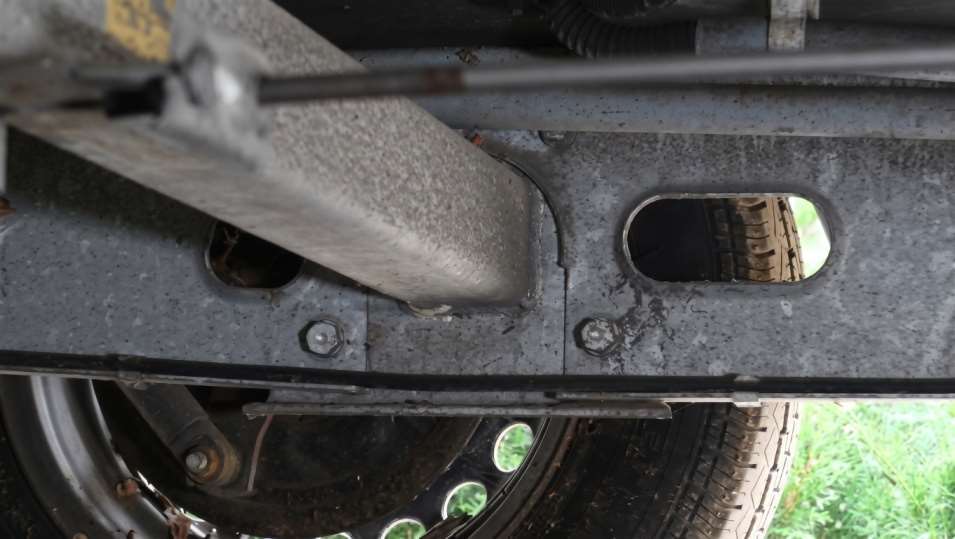
Chinese frames are cheaper. That’s why they’re bought in China and shipped to Europe disassembled. And here’s the result. If the bolted joints of a European trailer’s frame loosen, the frame bends into a bow shape. And since all the furniture in a European trailer is attached to the frame, the furniture folds up like an accordion, and waves appear on the trailer’s walls.
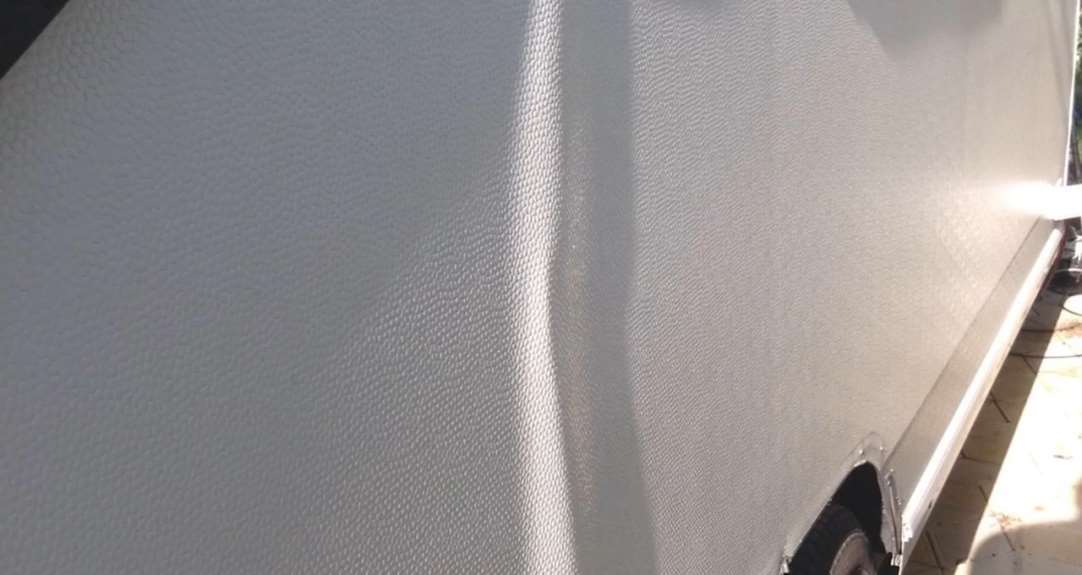
Naturally, none of this happens with American trailers.
Walls of European and American Trailers
The Slide-Out (an extendable wall section on American trailers)
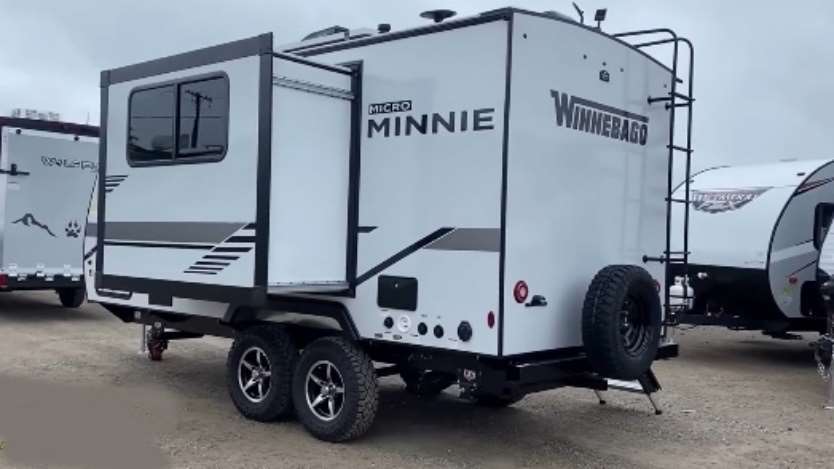
Slide-outs are only found on American trailers. European trailers don’t have them.
The reason European trailers have no slide-outs is the materials they’re made of. You have to agree, it’s very hard, practically impossible, to build a slide-out into the plywood framing of a European trailer.
An American trailer has aluminum framing, so a slide-out is easy to accommodate.
Wall Materials of European and American Trailers
The walls of European trailers are made of smooth aluminum sheet on a plywood base.
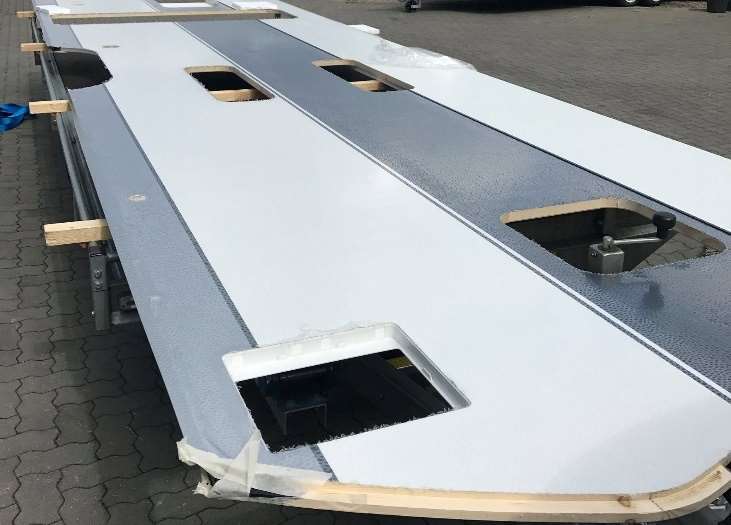
Smooth aluminum is prone to cracking due to thermal expansion and contraction. The problem is that when this kind of aluminum expands or contracts, it has no room to move, so cracks appear. And they appear precisely at the corners of the door.
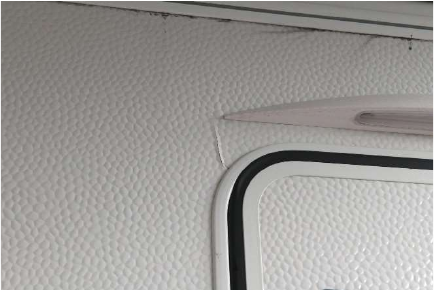
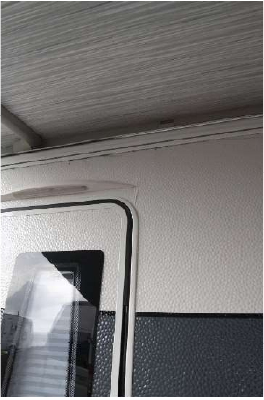
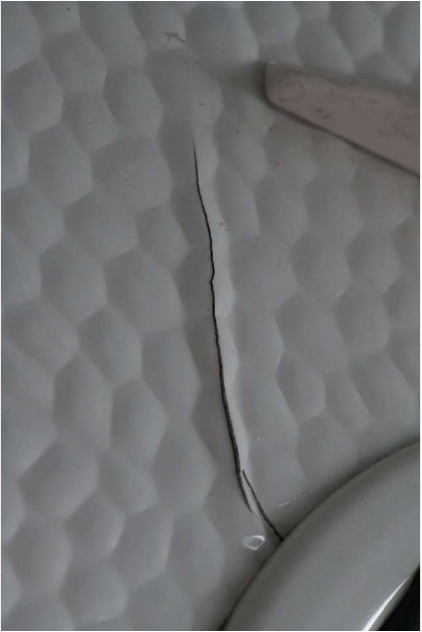
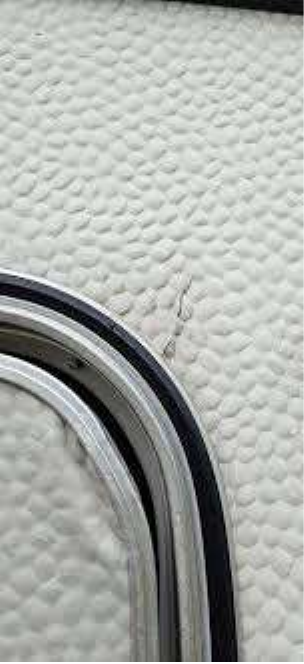
Engineers learned about this phenomenon in the early 1950s, at the dawn of commercial jet aviation. It was cracks like these at the corners of square windows that caused several crashes of the British Comet 4 airliner. The government spent millions of pounds to find the cause. That’s why all passenger aircraft windows are rounded today. In aviation, this phenomenon proved critical; in European trailer manufacturing, it’s merely a nuisance.
In American trailers, the aluminum walls are corrugated, which prevents fatigue cracks.
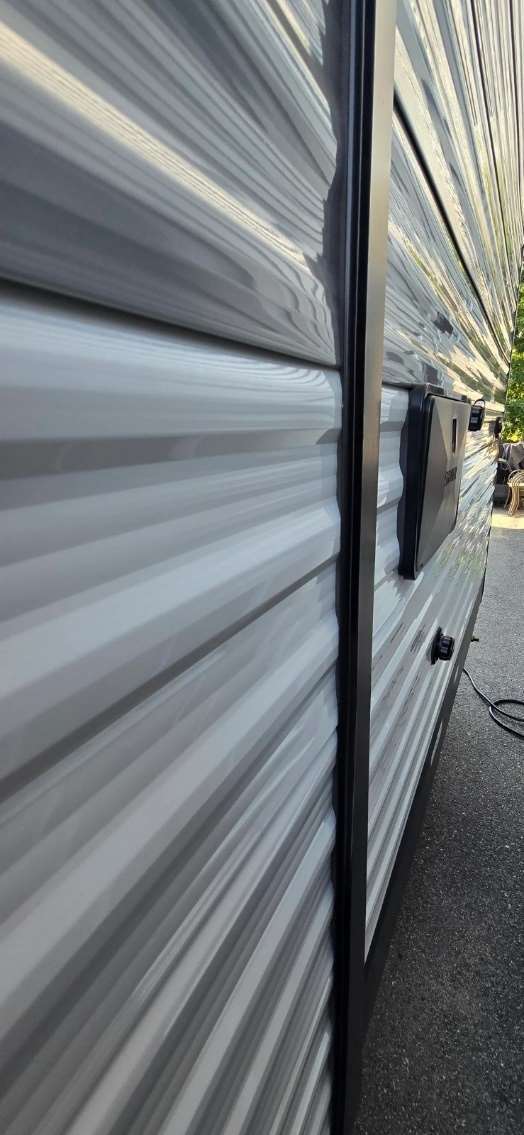
The framing of European trailers is made of plywood. This makes it impossible to fit European trailers with slide-outs or one-touch power awnings. Setting up the awning on a European trailer takes a long time and two people.
An American trailer has aluminum framing, which makes it possible to fit a motorized power awning and a slide-out. What’s more, the awning on an American trailer retracts automatically when the wind picks up.
On a European trailer, the awning has to be set up by hand, and it doesn’t retract automatically in strong wind, which leads to frequent damage.
In addition to corrugated aluminum walls, most American trailers and motorhomes have AZDEL walls. This is a new technology in RV manufacturing.
AZDEL is a modern composite material made of polypropylene (a thermoplastic resin) and fiberglass. It comes in lightweight but extremely strong panels. Unlike wood, AZDEL doesn’t absorb moisture at all. That means it doesn’t rot, grow mold, or delaminate when exposed to water. This composite is about 50% lighter than traditional wood plywood of the same thickness, which reduces the overall weight of the trailer. AZDEL panels insulate three times better than wood. The material also has excellent sound absorption and resists impacts and punctures. What’s more, AZDEL doesn’t emit toxic gases (including formaldehyde) and has no odor.
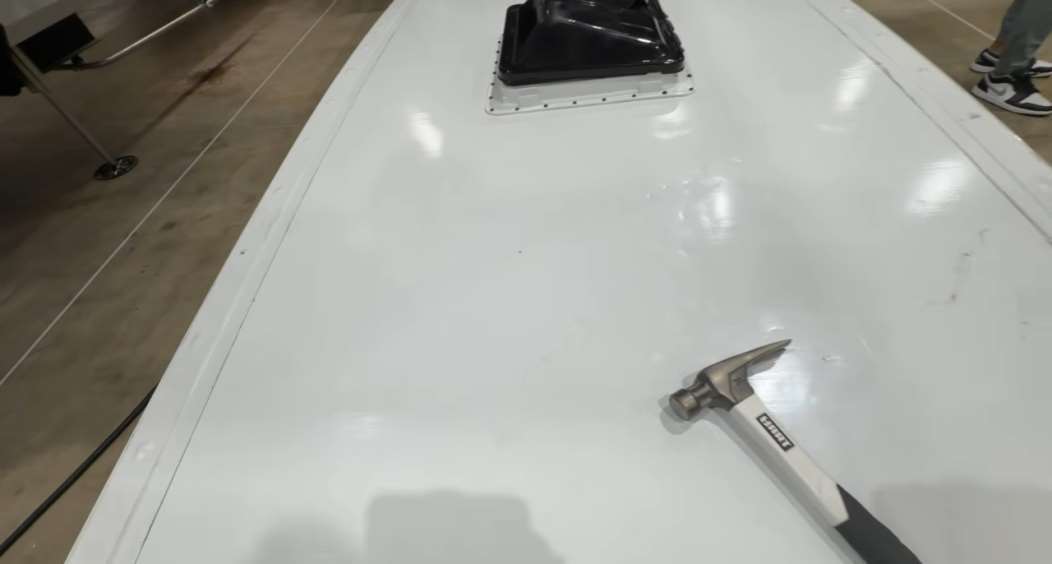
European trailers don’t have AZDEL walls.
The Roof of American and European Trailers
The roof of an American trailer is made of a special material: olefin. Olefins are unsaturated hydrocarbons with a double bond, and the word also refers to a strong synthetic polypropylene fabric. Rubber is added to the material to reduce rain noise. This makes the roof walkable, for example, to clean solar panels or to load extra cargo. The rear-mounted roof ladders are proof of that.
In European trailers, the roof is made of ordinary plastic. Walking on the roof of a European trailer is strictly prohibited.
Equipment That Makes Setting Up and Hitching Easier
Stabilizer Jacks
Most American trailers have powered stabilizer jacks. You can set up the trailer at a campsite or parking spot at the push of two buttons. Some American trailers also have an automatic leveling system.
These are very important features. We usually set up our trailers tired, after a long drive. Having to crank things and check the level is no fun. American trailers have solved this problem.
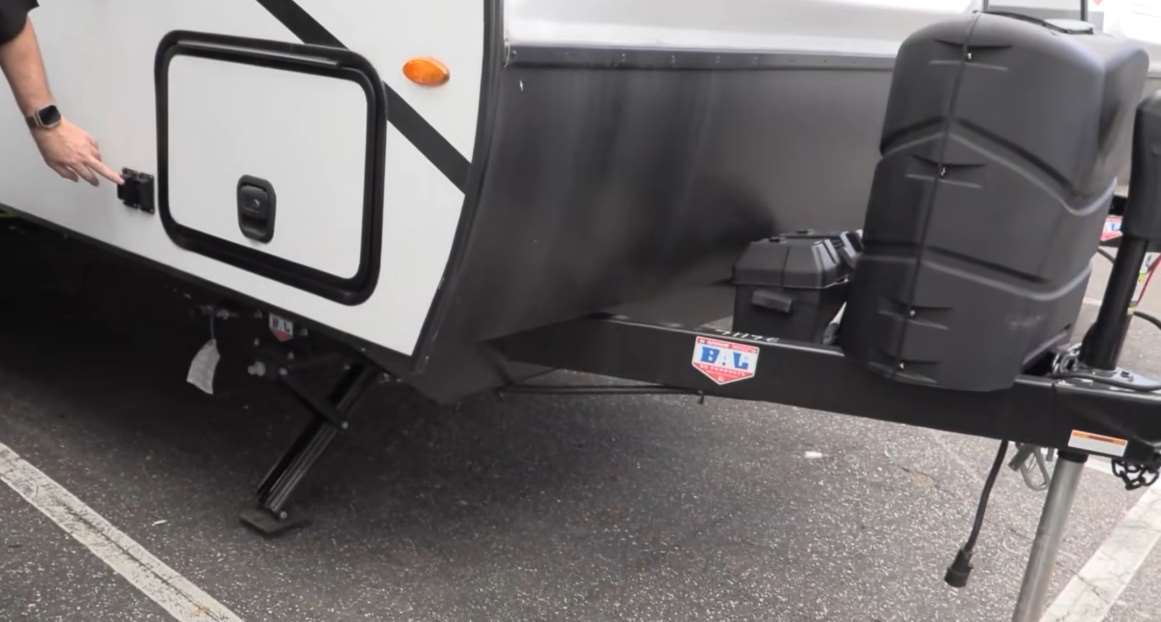
European trailers have nothing like this. Their owners have to crank and check the level, tired as they are.
Hitching and Unhitching
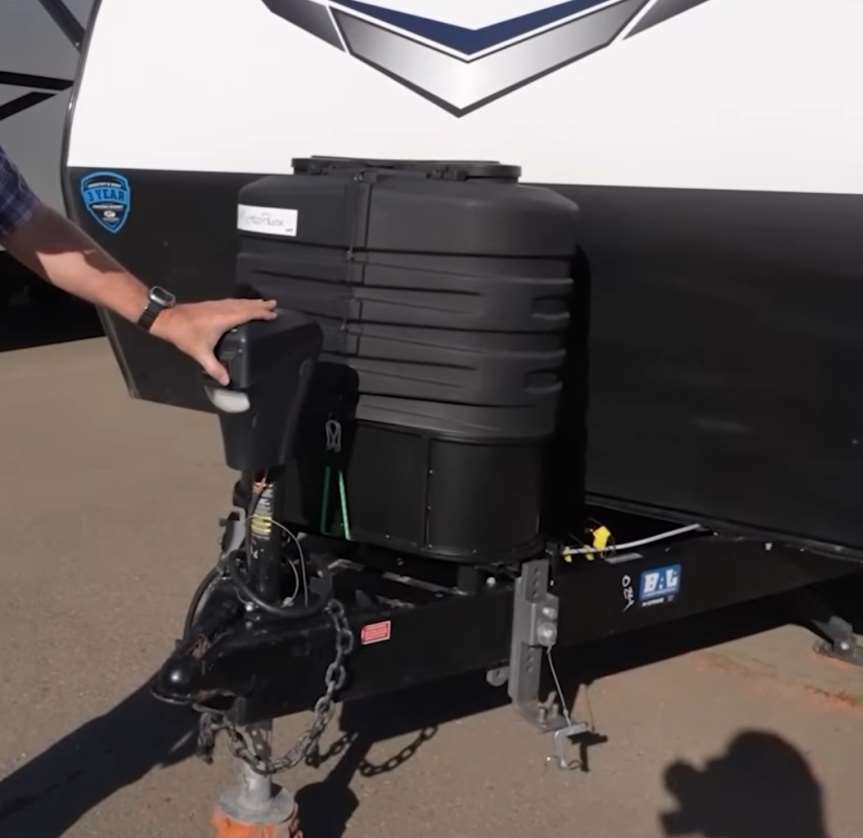
An American trailer’s tongue jack is motorized, so you can easily hitch the trailer to the tow vehicle and unhitch it at the push of a button.
Not a single European trailer has a motorized tongue jack. Hitching or unhitching means physical work: cranking a screw jack by hand.
Towing Performance of American and European Trailers and Tongue Weight
Axle Placement
In a European trailer, the axles are placed in the middle of the frame. That means a European trailer behaves like a pendulum on the road. If you’re towing at over 90 km/h (56 mph) and a minivan passes you at 140 km/h (87 mph), a European trailer immediately starts to sway, which can lead to a serious accident. And if the weight in a European trailer shifts toward the rear, its tendency to sway at speed gets even worse.
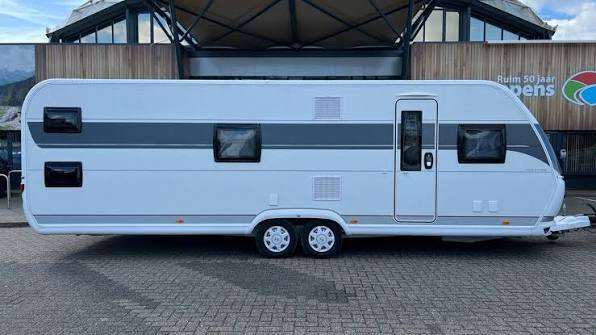
That’s why you can’t mount extra generators or cargo on the back of a European trailer.
In an American trailer, the axles are set further back. That makes it a pendulum with a strongly offset center of gravity, and it’s very hard, if not impossible, to make it sway. This allows towing speeds of up to 140 km/h (87 mph) and makes towing more stable. With the axles set back, an American trailer can carry an onboard generator and various cargo on the rear.
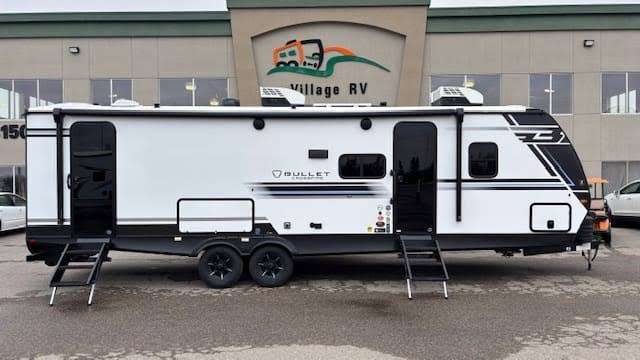
Tongue Weight on the Tow Vehicle’s Hitch Ball
Because the axles on a European trailer are in the middle, the tongue weight is low. That’s why, in this respect, every European trailer suits every European tow vehicle. Under the European standard, tongue weight must not exceed 140 kg (309 lb).
In an American trailer, the axles are set back, so the tongue weight is higher. If the tongue weight exceeds 140 kg (309 lb), you need a body-on-frame tow vehicle, and those are hardly made in Europe. However, American manufacturers build many trailers for unibody tow vehicles that can be used in Europe. Here is a list of American trailers with a tongue weight under 140 kg (309 lb). These are the ones that will work with European unibody tow vehicles.
| Hard-sided | Aliner | Ascape ST | 2026 | 102.1 kg (225 lb) |
| Teardrop / micro camper | Bontrager Outdoors | Standard 15FK | Year not specified | 127.0 kg (280 lb) |
| Teardrop / micro camper | Bontrager Outdoors | Standard 15RE | Year not specified | 127.0 kg (280 lb) |
| Teardrop / micro camper | Bontrager Outdoors | Standard 17FD | Year not specified | 138.8 kg (306 lb) |
| Hard-sided | Bowlus | 95th Anniversary | 2025 | 136.1 kg (300 lb) |
| Hard-sided | Bowlus | Rivet | 2026 | 136.1 kg (300 lb) |
| Hard-sided | Bowlus | Terra Firma | 2024 | 136.1 kg (300 lb) |
| Hard-sided | Bowlus | Volterra | 2024 | 136.1 kg (300 lb) |
| Hard-sided | Coachmen | Catalina Summit Series 7 134BHX | 2027 | 138.8 kg (306 lb) |
| Hard-sided | Coachmen | Catalina Summit Series 7 134REX | 2027 | 135.2 kg (298 lb) |
| Hard-sided | Coachmen | Catalina Summit Series 7 134RKX | 2027 | 137.9 kg (304 lb) |
| Hard-sided | Coachmen | Clipper 14R | 2026 | 113.4 kg (250 lb) |
| Hard-sided | Coachmen | Clipper Cadet 17CBH | 2026 | 136.1 kg (300 lb) |
| Hard-sided | Coachmen | Clipper ROK 8000ROK | 2026 | 115.7 kg (255 lb) |
| Hard-sided | Coachmen | Clipper ROK 9000ROK | 2026 | 81.6 kg (180 lb) |
| Hard-sided | Coachmen | Clipper ROK 11000ROK | 2026 | 120.2 kg (265 lb) |
| Hard-sided | Coachmen | Clipper ROK 12000ROK | 2026 | 102.1 kg (225 lb) |
| Hard-sided | Coachmen | Clipper ROK 13000ROK | 2026 | 124.7 kg (275 lb) |
| Hard-sided | Coachmen | Remote 13R | 2026–2027 | 139.7 kg (308 lb) |
| Hard-sided | Coachmen | Shasta I-5 Compact 16RE | 2027 | 139.7 kg (308 lb) |
| Hard-sided | Coachmen | Shasta I-5 Compact 17LB | 2027 | 133.4 kg (294 lb) |
| Hard-sided | CrossRoads | Zinger Lite Mini 12RD | 2026 | 108.9 kg (240 lb) |
| Hard-sided | Encore ROG | 12BH SS | 2024–2025 | 136.5 kg (301 lb) |
| Hard-sided | Forest River | Flagstaff E-Pro E11LE | 2026–2027 | 95.3–103.0 kg (210–227 lb) |
| Hard-sided | Forest River | Flagstaff E-Pro E12S | 2024 | 90.7 kg (200 lb) |
| Hard-sided | Forest River | Flagstaff E-Pro E14D / E14DA | 2024–2025 | 131.5 kg (290 lb) |
| Hard-sided | Forest River | Flagstaff E-Pro E17LE | 2026 | 138.3 kg (305 lb) |
| Hard-sided | Forest River | Flagstaff E-Pro E131BLE | 2027 | 129.3 kg (285 lb) |
| Hard-sided | Forest River | Flagstaff E-Pro E131DLE | 2027 | 124.7 kg (275 lb) |
| Hard-sided | Forest River | No Boundaries NB18.1 | 2025–2026 | 138.3 kg (305 lb) |
| Hard-sided | Forest River | r-pod RP-153 | 2026 | 131.5 kg (290 lb) |
| Hard-sided | Forest River | Rockwood Geo Pro G11LE | 2027 | 103.0 kg (227 lb) |
| Hard-sided | Forest River | Rockwood Geo Pro G12S | 2024–2025 | 90.7 kg (200 lb) |
| Hard-sided | Forest River | Rockwood Geo Pro G13BLE | 2027 | 129.3 kg (285 lb) |
| Hard-sided | Forest River | Rockwood Geo Pro G13DLE | 2027 | 124.7 kg (275 lb) |
| Hard-sided | Forest River | Rockwood Geo Pro G14D / G14DA | 2024–2025 | 131.5 kg (290 lb) |
| Hard-sided | Forest River | Viking 14R | 2025 | 113.4 kg (250 lb) |
| Hard-sided | Forest River | Viking 14SR | 2024 | 113.4 kg (250 lb) |
| Hard-sided | Forest River | Viking SAGA 17SBH | 2026 | 136.1 kg (300 lb) |
| Hard-sided | Gulf Stream | Ameri-Lite Super Lite 14RE | 2025–2026 | 136.1 kg (300 lb) |
| Hard-sided | Gulf Stream | Conquest Lite 14RE | 2025–2026 | 136.1 kg (300 lb) |
| Hard-sided | Gulf Stream | Innsbruck Lite 14RE | 2025–2026 | 136.1 kg (300 lb) |
| Hard-sided | Gulf Stream | Kingsport Lite 14RE | 2025–2026 | 136.1 kg (300 lb) |
| Hard-sided | Gulf Stream | Trailmaster Lite 14RE | 2025–2026 | 136.1 kg (300 lb) |
| Hard-sided | Gulf Stream | Vintage Cruiser 17RWD | 2024–2025 | 108.9 kg (240 lb) |
| Hard-sided | Gulf Stream | Vintage Cruiser 17SCD | 2024–2026 | 136.1 kg (300 lb) |
| Hard-sided | Gulf Stream | Vista Cruiser 17RWD | 2024 | 108.9 kg (240 lb) |
| Hard-sided | Gulf Stream | Vista Cruiser 17SCD | 2024 | 136.1 kg (300 lb) |
| Hard-sided | Heartland | Prowler 1700RB | 2026 | 122.5 kg (270 lb) |
| Hard-sided | Heartland | Prowler 1800BH East Coast | 2026 | 131.5 kg (290 lb) |
| Hard-sided | Highland Ridge | Open Range Colt 17QB | 2026 | 122.5 kg (270 lb) |
| Hard-sided | Highland Ridge | Open Range Conventional 177BH | 2025–2026 | 129.3 kg (285 lb) |
| Hard-sided | Jayco | Jay Feather Air SL 15TBSL | 2026–2027 | 104.3 kg (230 lb) |
| Hard-sided | Jayco | Jay Feather Air SL 17BHSL | 2026–2027 | 113.4–131.5 kg (250–290 lb) |
| Hard-sided | Jayco | Jay Feather Air SL 17RBSL | 2027 | 140.6 kg (310 lb) |
| Hard-sided | Jayco | Jay Flight SLX 130BH | 2026 | 117.9 kg (260 lb) |
| Hard-sided | Jayco | Jay Flight SLX 130BHW | 2026 | 117.9 kg (260 lb) |
| Hard-sided | Jayco | Jay Flight SLX 130RD | 2026 | 99.8 kg (220 lb) |
| Hard-sided | Jayco | Jay Flight SLX 130RDW | 2026 | 115.7 kg (255 lb) |
| Hard-sided | Jayco | Jay Flight SLX 140TB | 2026 | 122.5 kg (270 lb) |
| Hard-sided | Jayco | Jay Flight SLX 140TBW | 2026 | 115.7 kg (255 lb) |
| Hard-sided | Jayco | Jay Flight SLX 154BH | 2024 | 122.5 kg (270 lb) |
| Hard-sided | Jayco | Jay Flight SLX 154BHW | 2024 | 133.8 kg (295 lb) |
| Hard-sided | Jayco | Jay Flight SLX 170FQ | 2025–2026 | 115.7–120.2 kg (255–265 lb) |
| Hard-sided | Jayco | Jay Flight SLX 170FQW | 2025–2026 | 115.7–120.2 kg (255–265 lb) |
| Hard-sided | Jayco | Jay Flight SLX 175BH | 2025 | 138.3 kg (305 lb) |
| Hard-sided | Jayco | Jay Flight SLX 175BHW | 2025 | 138.3 kg (305 lb) |
| Hard-sided | Jayco | Jay Flight SLX 175FQ | 2025–2026 | 137.9–138.3 kg (304–305 lb) |
| Hard-sided | Jayco | Jay Flight SLX 195RB | 2024 | 133.8 kg (295 lb) |
| Hard-sided | Jayco | Jay Flight SLX 195RBW | 2024 | 133.8 kg (295 lb) |
| Hard-sided | Jayco | Jay Flight Sport 130BH | 2027 | 108.9 kg (240 lb) |
| Hard-sided | Jayco | Jay Flight Sport 140TBW | 2027 | 140.6 kg (310 lb) |
| Hard-sided | Jayco | Jay Flight Sport 170FQW | 2027 | 127.0 kg (280 lb) |
| Hard-sided | Keystone | Coleman Light 17RX | 2025–2026 | 136.1 kg (300 lb) |
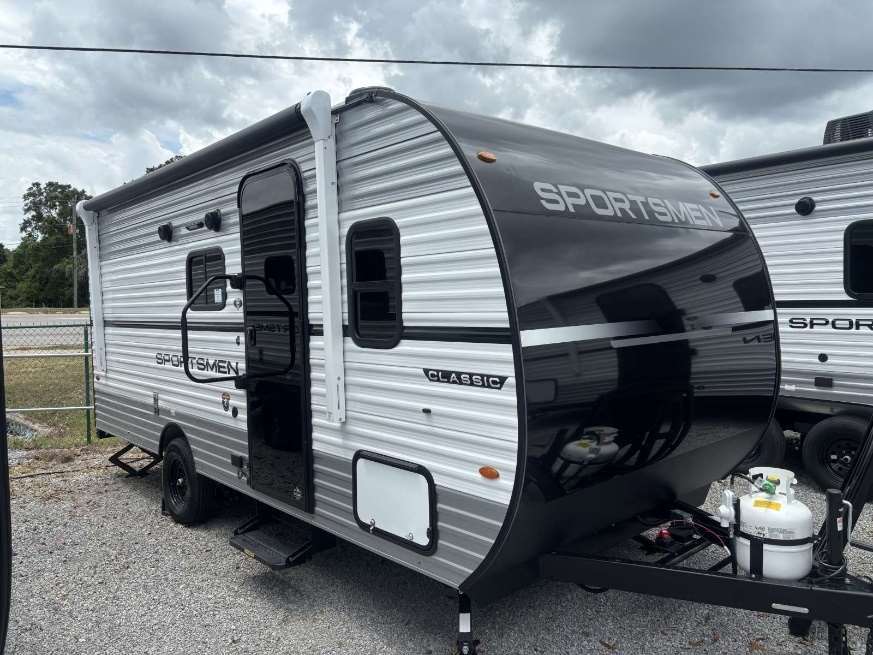
| Hard-sided | KZ | Sportsmen Classic 130BH | 2025–2026 | 122.5–131.5 kg (270–290 lb) |
| Hard-sided | KZ | Sportsmen Classic 130RB | 2024–2025 | 122.5–136.1 kg (270–300 lb) |
| Hard-sided | KZ | Sportsmen Classic 130RD | 2025–2026 | 117.9–122.5 kg (260–270 lb) |
| Hard-sided | KZ | Sportsmen Classic 180BH | 2024, 2026 | 131.5–136.1 kg (290–300 lb) |
| Hard-sided | LIV | 13BH | 2026 | 124.7 kg (275 lb) |
| Hard-sided | LIV | 13SD | 2026 | 124.7 kg (275 lb) |
| Hard-sided | LIV | 16FL | 2026 | 113.4 kg (250 lb) |
| Hard-sided | LIV | 17BH | 2026 | 113.4 kg (250 lb) |
| Hard-sided | Riverside RV | Retro 135 | 2024–2025 | 72.6 kg (160 lb) |
| Hard-sided | Riverside RV | Retro 165 | 2024 | 136.1 kg (300 lb) |
| Hard-sided | Sunset Park RV | Sun Lite 13BD | 2026 | 113.4 kg (250 lb) |
| Hard-sided | Sunset Park RV | Sun Lite 13BH | 2026 | 124.7 kg (275 lb) |
| Hard-sided | Sunset Park RV | Sun Lite 13MJ | 2026 | 122.5 kg (270 lb) |
| Hard-sided | Sunset Park RV | Sun Lite 14FD | 2026 | 108.9 kg (240 lb) |
| Hard-sided | Sunset Park RV | Sun Lite 14RB | 2026 | 124.7 kg (275 lb) |
| Hard-sided | Sunset Park RV | Sun Lite 15MB | 2026 | 108.9 kg (240 lb) |
| Hard-sided | Sunset Park RV | Sun Lite 15MBX | 2026 | 108.9 kg (240 lb) |
| Hard-sided | Sunset Park RV | Sun Lite 16BH | 2026 | 104.3 kg (230 lb) |
| Hard-sided | Sunset Park RV | Sun Lite 18RD | 2026 | 115.7 kg (255 lb) |
| Hard-sided | Sunset Park RV | Sun Lite 19RK | 2026 | 133.8 kg (295 lb) |
| Hard-sided | Sunset Park RV | Sun Lite LTD 19RK | 2024–2025 | 124.7 kg (275 lb) |
| Hard-sided | Travel Lite | Rove Classic 14BHC | 2025 | 113.4 kg (250 lb) |
| Hard-sided | Travel Lite | Rove Lite 14BH | 2024–2025 | 83.5 kg (184 lb) |
| Hard-sided | Travel Lite | Rove Lite 14FB | 2024–2025 | 112.5 kg (248 lb) |
| Hard-sided | Travel Lite | Rove Lite 14FBS | 2024–2025 | 113.4–130.6 kg (250–288 lb) |
| Hard-sided | Travel Lite | Rove Lite 14FD | 2024–2025 | 85.3 kg (188 lb) |
| Hard-sided | Travel Lite | Rove Lite 14FL | 2024–2025 | 99.8 kg (220 lb) |
| Hard-sided | Travel Lite | Rove Lite 16RB | 2024–2025 | 69.9 kg (154 lb) |
| Hard-sided | Travel Lite | Rove XL 17CC | 2026 | 131.5 kg (290 lb) |
| Hard-sided | Wayfinder | Go Play 173MD Sport | 2026 | 129.3 kg (285 lb) |
| Hard-sided | Wayfinder | Go Play 177BH Sport | 2026 | 129.3 kg (285 lb) |
| Fiberglass shell | Happier Camper | HC1 / HC1 Venture | 2024–2026 | 49.9–68.0 kg (110–150 lb) |
| Fiberglass shell | Happier Camper | HC1 Studio | 2024–2026 | 81.6–99.8 kg (180–220 lb) |
| Fiberglass shell | Scamp | 13 — Standard, Deluxe, X | 2026 | 81.6–131.5 kg (180–290 lb) |
| Fiberglass shell | Scamp | 13 Lite | 2026 | 68.0 kg (150 lb) |
| Fiberglass shell | Scamp | 16 — Standard, Deluxe | 2026 | 79.4–113.4 kg (175–250 lb) |
| Fiberglass shell | Scamp | 16 Lite | 2026 | 68.0 kg (150 lb) |
| Folding A-frame | Aliner | Amp | 2024–2026 | 90.7 kg (200 lb) |
| Folding A-frame | Aliner | Classic — Rear Sofa / Mattress, Twin Bed | 2024–2026 | 72.6 kg (160 lb) |
| Folding A-frame | Aliner | Evolution 12 | 2024–2026 | 95.3 kg (210 lb) |
| Folding A-frame | Aliner | Evolution 15 | 2024–2026 | 90.7 kg (200 lb) |
| Folding A-frame | Aliner | Evolution 15 Twin Bed | Year not specified | 108.9 kg (240 lb) |
| Folding A-frame | Aliner | Evolution LG | Year not specified | 108.9 kg (240 lb) |
| Folding A-frame | Aliner | Expedition | 2024–2026 | 108.9 kg (240 lb) |
| Folding A-frame | Aliner | LXE | 2024–2026 | 81.6 kg (180 lb) |
| Folding A-frame | Aliner | Ranger 10 | 2024–2026 | 79.4 kg (175 lb) |
| Folding A-frame | Aliner | Ranger 12 | 2024–2026 | 68.0 kg (150 lb) |
| Folding A-frame | Aliner | Scout | 2024–2026 | 59.0 kg (130 lb) |
| Folding A-frame | Aliner | Scout 15 | 2024–2026 | 131.5 kg (290 lb) |
| Folding A-frame | Aliner | Scout Lite | 2024–2026 | 59.0 kg (130 lb) |
| Folding A-frame | Forest River | Flagstaff A-Frame T10RB | 2026–2027 | 103.4–117.9 kg (228–260 lb) |
| Folding A-frame | Forest River | Flagstaff A-Frame T12FD | 2026–2027 | 112.0 kg (247 lb) |
| Folding A-frame | Forest River | Flagstaff A-Frame T12RG | 2027 | 140.6 kg (310 lb) |
| Folding A-frame | Forest River | Flagstaff A-Frame T12ST | 2026–2027 | 128.8 kg (284 lb) |
| Folding A-frame | Forest River | Flagstaff A-Frame T21HS | 2026–2027 | 138.3 kg (305 lb) |
| Folding A-frame | Forest River | Rockwood A-Frame A101RB | 2027 | 117.9 kg (260 lb) |
| Folding A-frame | Forest River | Rockwood A-Frame A121FD | 2027 | 112.0 kg (247 lb) |
| Folding A-frame | Forest River | Rockwood A-Frame A122S | 2027 | 128.8 kg (284 lb) |
| Folding A-frame | Forest River | Rockwood A-Frame A123RG | 2027 | 140.6 kg (310 lb) |
| Folding A-frame | Forest River | Rockwood A-Frame A213HS | 2027 | 138.3 kg (305 lb) |
| Hard-sided pop-up | Forest River | Rockwood A101LE | 2026 | 115.7 kg (255 lb) |
| Hard-sided pop-up | TrailManor | 2518KB | 2026 | 133.8 kg (295 lb) |
| Hard-sided pop-up | TrailManor | TM16 S | 2026 | 136.1 kg (300 lb) |
| Tent pop-up | Forest River | Flagstaff Tent 164MT | 2026–2027 | 113.4 kg (250 lb) |
| Tent pop-up | Forest River | Flagstaff Tent 192MT | 2026 | 108.9 kg (240 lb) |
| Tent pop-up | Forest River | Flagstaff Tent 193MT | 2026–2027 | 106.6 kg (235 lb) |
| Tent pop-up | Forest River | Flagstaff Tent 227MT | 2026–2027 | 136.1 kg (300 lb) |
| Tent pop-up | Forest River | Flagstaff Tent 238MT | 2026–2027 | 131.5 kg (290 lb) |
| Tent pop-up | Forest River | Flagstaff Tent F141OTG | 2026–2027 | 73.5 kg (162 lb) |
| Tent pop-up | Forest River | Flagstaff Tent F171OTG | 2026–2027 | 83.0 kg (183 lb) |
| Tent pop-up | Forest River | Rockwood Tent 16OTG | 2026–2027 | 73.5 kg (162 lb) |
| Tent pop-up | Forest River | Rockwood Tent 19OTG | 2026–2027 | 83.0 kg (183 lb) |
| Tent pop-up | Forest River | Rockwood Tent 1640FT | 2026–2027 | 113.4 kg (250 lb) |
| Tent pop-up | Forest River | Rockwood Tent 1920FT | 2026 | 108.9 kg (240 lb) |
| Tent pop-up | Forest River | Rockwood Tent 1930FT | 2026–2027 | 106.6 kg (235 lb) |
| Tent pop-up | Forest River | Rockwood Tent 2270FT | 2026–2027 | 136.1 kg (300 lb) |
| Tent pop-up | Forest River | Rockwood Tent 2380FT | 2026–2027 | 131.5 kg (290 lb) |
| Tent pop-up | SylvanSport | GO | 2024–2026 | 38.6 kg (85 lb) |
| Tent pop-up | SylvanSport | GO All-Terrain | 2024–2026 | 38.6 kg (85 lb) |
| Tent pop-up | SylvanSport | GOAT | 2024–2027 | 108.9 kg (240 lb) |
| Tent pop-up Off-road | SylvanSport | Vire | 2024–2026 | 108.9 kg (240 lb) |
| Off-road micro camper | Boreas | XT | 2026 | 95.3 kg (210 lb) |
| Off-road micro camper | Mammoth Overland | HV | 2026 | 127.0 kg (280 lb) |
| Teardrop / micro camper | Bean Trailer | Bean Pod | 2024–2026 | 63.5 kg (140 lb) |
| Teardrop / micro camper | Bean Trailer | Bean Stock / Bean Stock 2.0 | 2024–2026 | 63.5 kg (140 lb) |
| Teardrop / micro camper | Bean Trailer | Bean Stock X | 2024–2026 | 93.0 kg (205 lb) |
| Teardrop / micro camper | Bean Trailer | Mean Bean | 2024–2026 | 81.6 kg (180 lb) |
| Teardrop / micro camper | Bean Trailer | Meaner Bean | 2024–2026 | 90.7 kg (200 lb) |
| Teardrop / micro camper | Bontrager Outdoors | Compact 7ROD | Year not specified | 28.6 kg (63 lb) |
| Teardrop / micro camper | Bontrager Outdoors | Compact 10HD | Year not specified | 63.5 kg (140 lb) |
| Teardrop / micro camper | Bontrager Outdoors | Compact 10ROK | Year not specified | 63.5 kg (140 lb) |
| Teardrop / micro camper | Bontrager Outdoors | Compact 12ROK | Year not specified | 81.6 kg (180 lb) |
| Teardrop / micro camper | Bontrager Outdoors | Drifter 10ROK | Year not specified | 63.5 kg (140 lb) |
| Teardrop / micro camper | Bontrager Outdoors | Radical 10RAD | Year not specified | 63.5 kg (140 lb) |
| Teardrop / micro camper | Bontrager Outdoors | Radical 12RAD | Year not specified | 81.6 kg (180 lb) |
| Teardrop / micro camper | Ember RV | E-Series 12RK | 2026 | 106.6–115.7 kg (235–255 lb) |
| Teardrop / micro camper | Escapod | TOPO2 MTB | Year not specified | 113.4 kg (250 lb) |
| Teardrop / micro camper | Escapod | TOPO2 Nomad | Year not specified | 90.7 kg (200 lb) |
| Teardrop / micro camper | Escapod | TOPO2 Voyager | Year not specified | 113.4 kg (250 lb) |
| Teardrop / micro camper | Forest River | IBEX 10LHG | 2024 | 130.6 kg (288 lb) |
| Teardrop / micro camper | Forest River | IBEX 10LHRK | 2024 | 131.5 kg (290 lb) |
| Teardrop / micro camper | Forest River | No Boundaries NB10.4 | 2025–2026 | 129.3 kg (285 lb) |
| Teardrop / micro camper | Forest River | No Boundaries NB10.7 | 2025–2026 | 102.1–113.4 kg (225–250 lb) |
| Teardrop / micro camper | Forest River | Viking ROK 8000ROK | 2025–2026 | 115.7 kg (255 lb) |
| Teardrop / micro camper | Forest River | Viking ROK 9000ROK | 2026 | 115.7 kg (255 lb) |
| Teardrop / micro camper | Gulf Stream | Trail Boss 109OK | 2025 | 108.9 kg (240 lb) |
| Teardrop / micro camper | Hiker Trailers | Extreme Off Road 5 × 9 | 2024–2026 | 98.0 kg (216 lb) |
| Teardrop / micro camper | Hiker Trailers | Highway Deluxe 5 × 8 | 2024–2026 | 44.5 kg (98 lb) |
| Teardrop / micro camper | Hiker Trailers | Highway Deluxe 5 × 9 | 2024–2026 | 49.9 kg (110 lb) |
| Teardrop / micro camper | Hiker Trailers | Highway Deluxe 5 × 10 | 2024–2026 | 51.7 kg (114 lb) |
| Teardrop / micro camper | Hiker Trailers | Mid Range 5 × 8 | 2024–2026 | 49.9 kg (110 lb) |
| Teardrop / micro camper | Hiker Trailers | Mid Range 5 × 9 | 2024–2026 | 51.7 kg (110 lb) |
| Teardrop / micro camper | Hiker Trailers | Mid Range 5 × 10 | 2024–2026 | 53.5 kg (118 lb) |
| Teardrop / micro camper | Hiker Trailers | Mid Range XL 5 × 9 | 2024–2026 | 54.4 kg (120 lb) |
| Teardrop / micro camper | Hiker Trailers | Mid Range XL 5 × 10 | 2024–2026 | 58.1 kg (128 lb) |
| Teardrop / micro camper | inTech | Flyer Chase | Year not specified | 83.0–98.0 kg (183–216 lb) |
| Teardrop / micro camper | inTech | Flyer Explore | 2025–2026 | 113.4 kg (250 lb) |
| Teardrop / micro camper | inTech | Flyer Pursue | 2025–2026 | 108.9 kg (240 lb) |
| Teardrop / micro camper | inTech | Luna Rover | 2025–2026 | 117.9–122.5 kg (260–270 lb) |
| Teardrop / micro camper | Little Guy | Max Eco | 2024 | 126.1 kg (278 lb) |
| Teardrop / micro camper | Little Guy | Micro Max | 2024 | 111.1–117.9 kg (245–260 lb) |
| Teardrop / micro camper | Little Guy | Mini Max / Mini Max FX | 2024 | 98.0–113.4 kg (216–250 lb) |
| Teardrop / micro camper | nüCamp | TAB 320 Black Canyon | 2025–2026 | 94.3 kg (208 lb) |
| Teardrop / micro camper | nüCamp | TAB 320 Boondock | 2025–2026 | 91.6 kg (202 lb) |
| Teardrop / micro camper | nüCamp | TAB 320 Classic | 2025 | 97.5 kg (215 lb) |
| Teardrop / micro camper | nüCamp | TAB 320 CS-S | 2024 | 136.1 kg (300 lb) |
| Teardrop / micro camper | nüCamp | TAB 320 Lite | 2026 | 109.8 kg (242 lb) |
| Teardrop / micro camper | nüCamp | TAB 320 S Black Canyon | 2024 | 72.1 kg (159 lb) |
| Teardrop / micro camper | nüCamp | TAB 320 S Boondock | 2024 | 78.0 kg (172 lb) |
| Teardrop / micro camper | nüCamp | TAB 320 S Classic | 2024 | 57.2 kg (126 lb) |
| Teardrop / micro camper | nüCamp | TAG Black Canyon | 2024–2026 | 70.8–91.2 kg (156–201 lb) |
| Teardrop / micro camper | nüCamp | TAG Boondock | 2024–2026 | 78.0–88.9 kg (172–196 lb) |
| Teardrop / micro camper | nüCamp | TAG Classic | 2024–2025 | 61.2–77.6 kg (135–171 lb) |
| Teardrop / micro camper | nüCamp | TAG SE | 2025–2026 | 42.2 kg (93 lb) |
| Teardrop / micro camper | nüCamp | TAG XL Black Canyon | 2024–2025 | 76.2–88.0 kg (168–194 lb) |
| Teardrop / micro camper | nüCamp | TAG XL Boondock | 2024–2025 | 83.5–87.1 kg (184–192 lb) |
| Teardrop / micro camper | nüCamp | TAG XL Classic | 2024–2025 | 65.8–80.3 kg (145–177 lb) |
| Teardrop / micro camper | Sunset Park RV | Sunray 109 | 2026 | 97.5 kg (215 lb) |
| Teardrop / micro camper | Sunset Park RV | Sunray 109E | 2026 | 97.5 kg (215 lb) |
| Teardrop / micro camper | Sunset Park RV | Sunray 119 | 2026 | 88.5 kg (195 lb) |
| Teardrop / micro camper | Sunset Park RV | Sunray 139T | 2026 | 106.6 kg (235 lb) |
| Teardrop / micro camper | TAXA Outdoors | Cricket Overland | 2025–2026 | 119.7 kg (264 lb) |
| Teardrop / micro camper | TAXA Outdoors | Cricket Standard | 2025 | 111.1 kg (245 lb) |
| Teardrop / micro camper | TAXA Outdoors | TigerMoth | 2024 | 57.6 kg (127 lb) |
| Teardrop / micro camper | TAXA Outdoors | TigerMoth Overland | 2025 | 57.6 kg (127 lb) |
Attaching the Walls to the Frame
Since a European trailer uses plywood for its body framing, it’s the plywood that’s attached to the frame with wooden pins known as dowels. This kind of wooden joint is extremely unreliable and isn’t designed for the heavy cyclic loads a European trailer is subjected to. Because of this design flaw, the plywood framing, a European trailer eventually turns into a shoe whose sole has come unglued at the toe. The floor separates from the walls at the front, because that’s usually where the extra water tank is installed. The trailer turns into a shoe with a toe made of lead.
The floor always separates at the worst possible moment: during a trip. The European trailer’s wiring gets caught in the gap, and the walls and floor start chewing on it like a crocodile’s jaws.
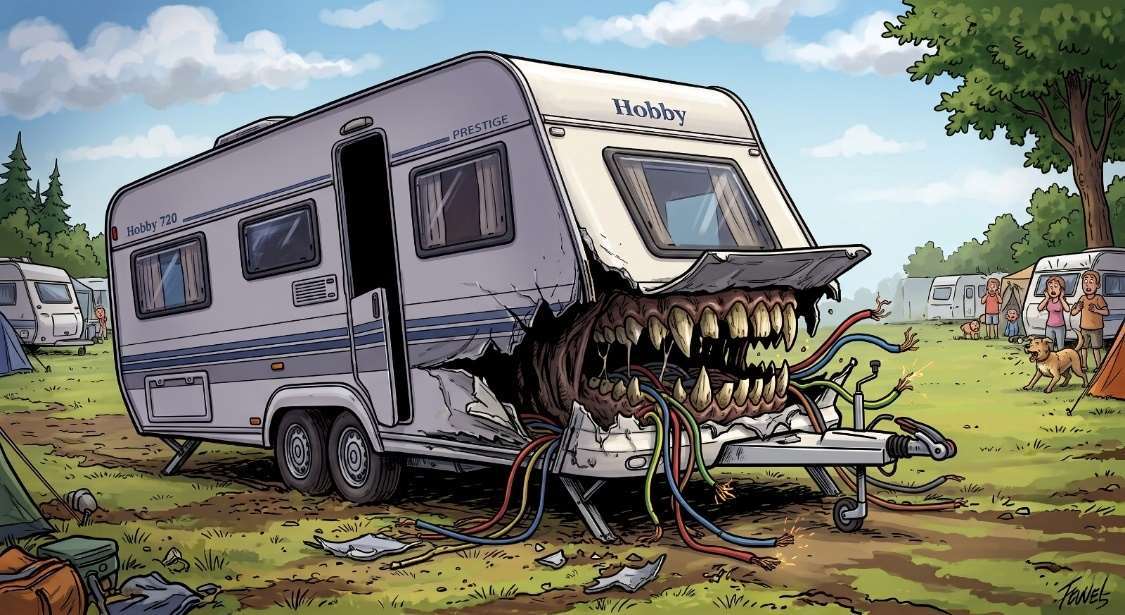
An American trailer’s body framing is made of strong aluminum, and that’s what gets attached to the trailer frame. The floor of an American trailer never separates from the walls.
Ground Clearance, Off-Road Capability, Suspension, and Shock Absorbers
Off-Road Capability
The ground clearance of a European trailer is 21–23 cm (8–9 in).
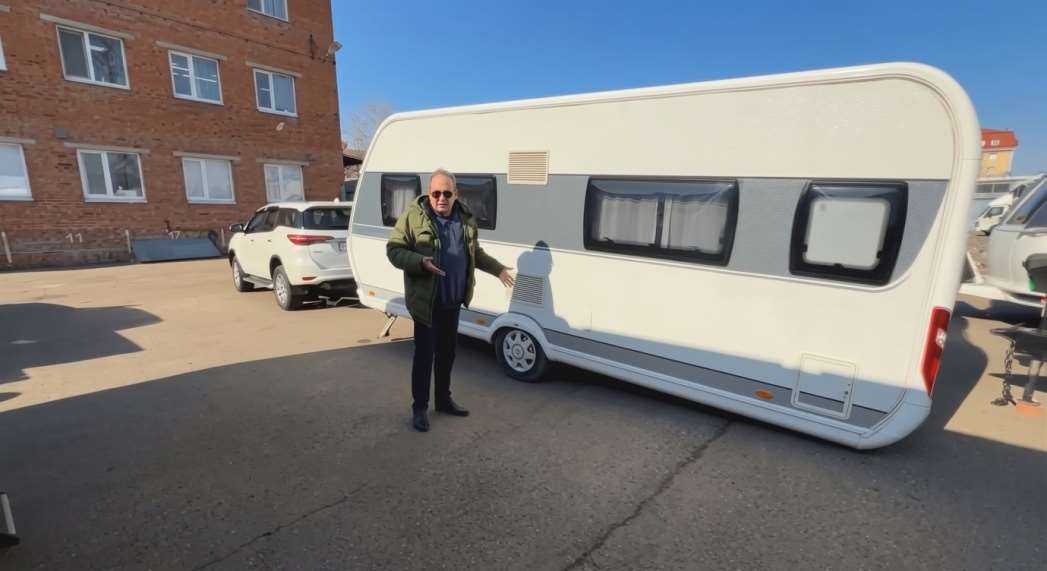
The ground clearance of an American trailer reaches up to 70 cm (27.5 in).
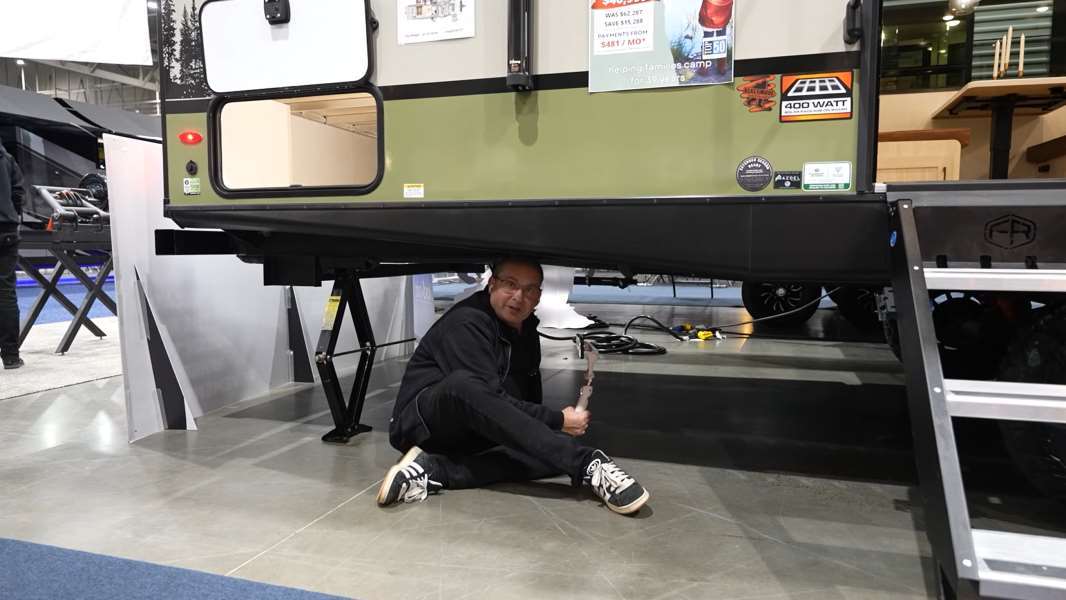
Some American trailers have independent suspension that lets you tow them on deeply rutted roads. American trailers built for hunters and anglers, such as NoBo and Winnebago, can ford deep rivers.
All American trailers are considered off-road capable. European trailers are designed for good roads only.
Shock Absorbers and Suspension
All European trailers have rubber torsion suspension only. It wears out over time and needs to be replaced once a year. As it wears, ground clearance drops from 21 cm to 17–18 cm (from about 8 in to 7 in). That’s a very unpleasant problem, because the European trailer practically drags on the ground. The fix is to replace the axles, which is expensive. Or you can install spacers, which raise the clearance but don’t improve the suspension.
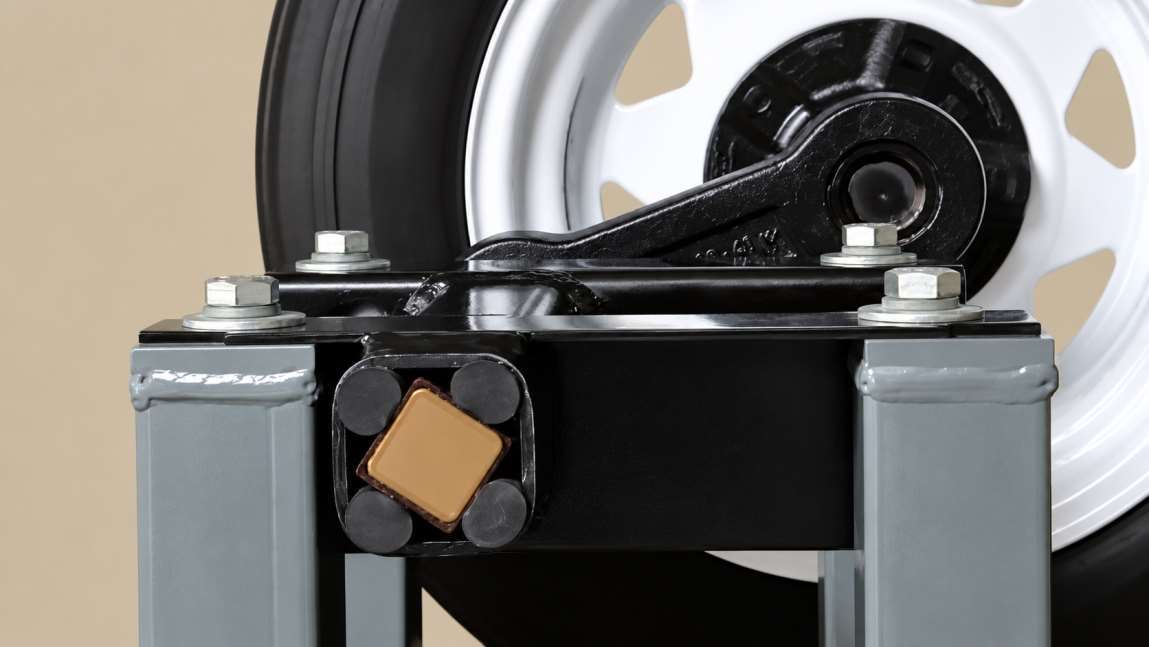
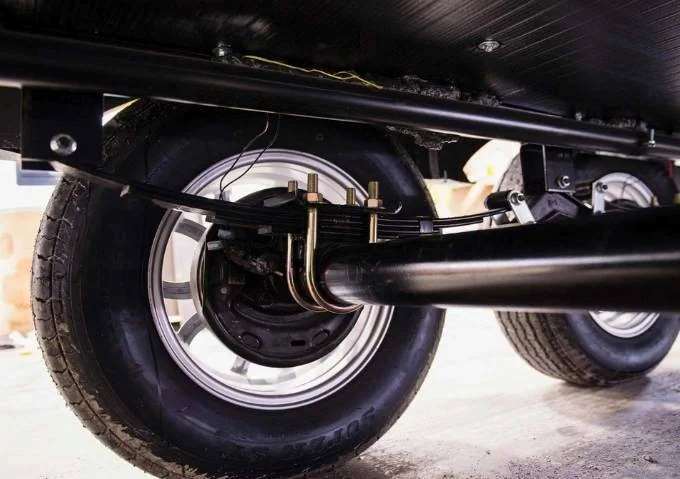
American trailers use leaf springs. They’re very tough and don’t need replacing, and if one breaks, it can be replaced at any truck repair shop, under any road conditions.
Furniture in European and American Trailers
Furniture in American trailers is made of solid wood. Furniture in all European trailers, without exception, is made of wood substitutes.
Refrigerators in European and American Trailers
Almost all European trailers are equipped with absorption refrigerators. The main drawbacks of these refrigerators are low efficiency and high power consumption when running on electricity. The main disadvantages of absorption systems are low efficiency and low cooling capacity: they have noticeably less cooling power than standard compressor models and take longer to reach the desired temperature.
American trailers are equipped with compressor refrigerators. The main advantage of compressor refrigerators over absorption ones is their high cooling efficiency and their ability to quickly freeze food to deep sub-zero temperatures (down to −18…−20 °C, or 0…−4 °F) regardless of the heat outside.
Price Comparison: A European Trailer and Its American Equivalent
Let’s compare two trailers. European: Hobby Excellent 460 SL, 6.76 m (22 ft 2 in)
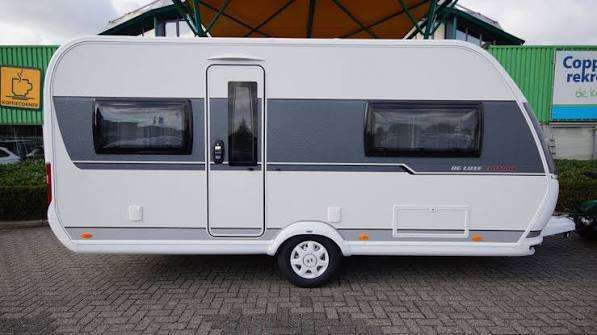
and Its American equivalent: K-Z Sportsmen 180BH, 6.4 m (21 ft), tongue weight up to 140 kg (309 lb)
Price of the Hobby Excellent 460 SL in Europe, without options, including VAT: €26,000 ($29,831)
Let’s add the options that already come standard on the American trailer.
| Option | Price, € | Price, $ |
| Air conditioner | €2,600 | $2,983 |
| Heated floor | €859 | $985 |
| Gas water heater | Not available for this model | — |
| Awning | €1,200 | $2,377 |
| Black polished alloy wheels | €951 | $1,091 |
| Weight rating increase to 1,500 kg (3,307 lb) with technical modification for single-axle models | €649 | $744 |
| Spare wheel with carrier instead of a tire repair kit, mounted under the floor | €529 | $606 |
| City water connection | €270 | $309 |
| Off-grid package: charge controller with booster, AGM 95 Ah battery, battery sensor, battery box | €947 | $1,087 |
| Dual USB charging outlet | €76 | $87 |
| Swivel TV mount, including necessary connectors | €339 | $388 |
| TRUMA Ultraheat | €634 | $727 |
In total, the full price of this European trailer with all the options that come standard on the American trailer is €34,971 ($40,024).
The price of its American equivalent in the US is $17,500. Let’s calculate what it would cost in Europe.
| Cost item | Amount, USD | Total, USD |
| Dealer price of the American trailer | $17,500 | $17,500 |
| State sales tax — 8% (approximate; varies by state) | $1,400 | $18,900 |
| Transport to the port (approximate) | $3,000 | $21,900 |
| RoRo shipping to Europe | $6,000 | $27,900 |
| European taxes — 19% | $5,301 | $33,201 |
Total: $33,201
As a result, for the European end buyer, a European trailer with all its drawbacks, plus the extra options installed (options that aren’t considered extras in America), will cost $40,024.
The equivalent American trailer, with all its advantages, all the options, all taxes, and delivery to Europe, will cost $33,201, which is $6,823 less.
Authors:
Konstantin Shchelbanin
Maria Shchelbanina